

TL;DR:
- Proper, detailed contracts that meet Arizona legal standards are essential to protect homeowners from costly remodeling mistakes.
- Verifying contractor licenses, insurance, and reputation ensures project reliability and helps prevent financial and legal risks.
Remodeling your home in the West Valley should be exciting, not a financial nightmare. Yet bad remodels are common in fast-growing Arizona markets like Phoenix, Goodyear, and Buckeye, and remediation costs can quickly dwarf the original project budget. The single most effective shield between a successful renovation and a costly disaster is a clear, legally compliant remodeling contract. This guide walks you through every essential element, from what Arizona law requires to how warranties work, so you can sign with confidence and protect your investment.
Table of Contents
- Arizona remodeling contracts: What must be included?
- How to verify your contractor: Licenses, insurance, and reputation
- Warranties and dispute resolution: What happens if things go wrong?
- Special cases: Historic homes, solar, and lead paint in Arizona
- What most Arizona homeowners misunderstand about remodeling contracts
- How Urban Edge can help you remodel with confidence
- Frequently asked questions
Key Takeaways
| Point | Details |
|---|---|
| Key contract elements | Arizona law lists specific mandatory details every remodeling contract must include. |
| Contractor verification | Confirm your remodeler is licensed, insured, and reputable using state resources before signing. |
| Warranty protections | Most remodeling work carries at least a 2-year warranty, with shorter terms for specific items. |
| Dispute solution options | Arizona’s ROC can help resolve contract-related complaints if problems arise. |
| Special property rules | Historic homes and solar or lead paint jobs often need extra contract and permit attention. |
Arizona remodeling contracts: What must be included?
Understanding what belongs in your contract is not just smart, it is legally required. Arizona takes residential remodeling seriously, and state law spells out exactly what a valid contract must contain. Knowing these requirements helps you spot a careless or dishonest contractor before you hand over a single dollar.
The mandatory elements under Arizona law
Arizona law (A.R.S. § 32-1158) mandates specific minimum elements in every residential remodeling contract. These include the contractor's full legal name, physical business address, and Arizona Registrar of Contractors (ROC) license number. The contract must also contain a detailed description of the work to be performed, the projected start date and estimated completion date, the total contract price or the basis on which the price will be determined, a list of materials to be used, a payment schedule, and required legal notices about the contractor's trust fund and bond status.
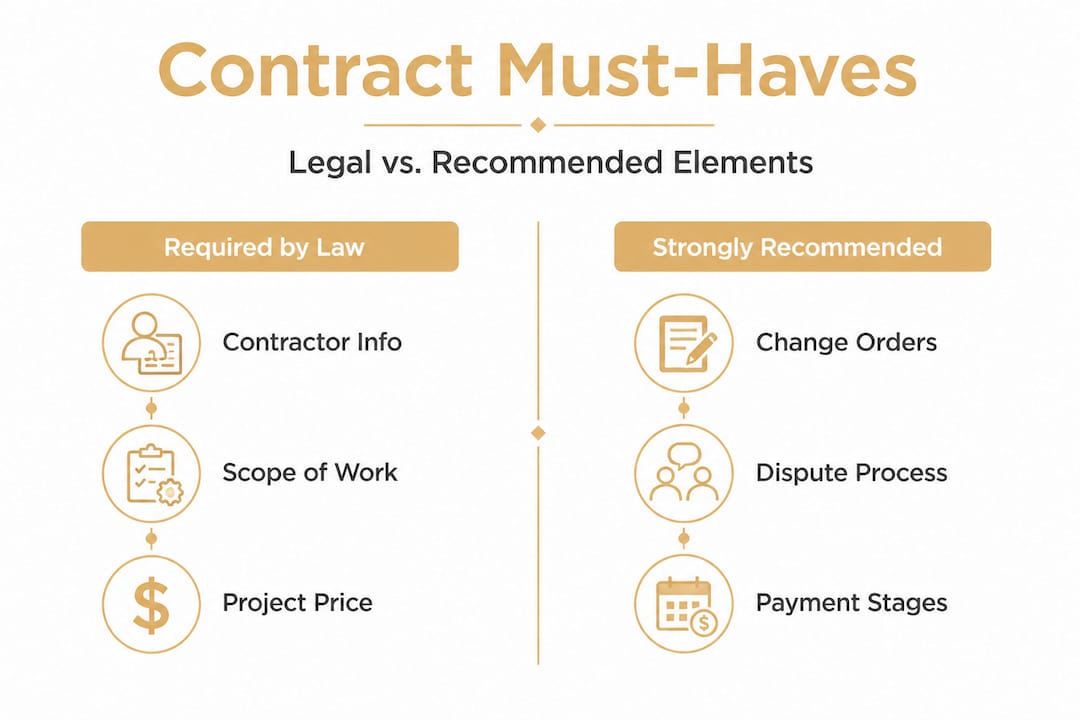
Each element exists for a specific protective reason. The license number lets you verify the contractor's standing with the ROC before work begins. The detailed work description prevents scope creep, which is the frustrating situation where a contractor expands the project and bills you for work you never agreed to. The payment schedule prevents you from paying everything upfront, which is one of the oldest tricks used by unscrupulous contractors who disappear with your money. The required legal notices inform you about protections in place if a contractor fails to pay subcontractors or suppliers, which could otherwise result in a lien placed against your home.
For a deeper look at what these remodeling contract requirements mean in practice, it helps to understand how general contracting works in Arizona from the ground up. You can also explore the essential contract elements that define a legally sound agreement before you sit down with any contractor.
Arizona statute A.R.S. § 32-1158 requires all residential remodeling contracts to include contractor identification, license number, detailed scope of work, start and completion dates, total price, materials list, payment schedule, and specific legal notices. Contracts missing these elements are not just sloppy, they may be unenforceable.
Here is a quick comparison of what is legally required versus what is strongly recommended but not mandated:
| Contract element | Required by Arizona law | Strongly recommended |
|---|---|---|
| Contractor name and ROC license number | Yes | Yes |
| Physical business address | Yes | Yes |
| Detailed work description | Yes | Yes |
| Start and estimated completion dates | Yes | Yes |
| Total price or price basis | Yes | Yes |
| Materials list | Yes | Yes |
| Payment schedule | Yes | Yes |
| Trust fund and bond notice | Yes | Yes |
| Change order process | No | Yes |
| Dispute resolution clause | No | Yes |
| Cleanup and debris removal | No | Yes |
| Photo documentation agreement | No | Yes |
| Subcontractor disclosure | No | Yes |
| Permit responsibility assignment | No | Yes |
Pro Tip: If your contractor sends a digital contract, print it and compare it line by line against the mandatory elements above. Digital contracts are just as legally binding as paper ones in Arizona, but formatting sometimes hides missing sections or buries critical notices in fine print at the bottom.
The "strongly recommended" column matters just as much in real life. A change order process, for example, prevents verbal misunderstandings about alterations to the original scope. If you agree verbally to upgrade your kitchen countertops mid-project and there is no written change order policy, disputes about who owes what become very hard to resolve.
How to verify your contractor: Licenses, insurance, and reputation
Even the most perfectly written contract means nothing if the person holding the pen is not who they claim to be. Verification is a non-negotiable step that every West Valley homeowner must take before signing anything.

Verify your contractor's Arizona ROC license, insurance, and bonding before you sign any agreement. The ROC website makes this process straightforward, but most homeowners simply skip it because they assume the contractor is legitimate. That assumption costs Arizona homeowners millions of dollars every year.
Here is a step-by-step process for verifying any contractor you are considering:
-
Visit the Arizona ROC website. Go to roc.az.gov and use the free license lookup tool. You will need either the contractor's name, company name, or license number to search.
-
Confirm the license is active. An expired or suspended license is a serious red flag. Active status means the contractor has met Arizona's ongoing requirements for education, bonding, and insurance.
-
Check the license classification. Arizona has different license types for different kinds of work. A contractor licensed for small commercial work may not have the correct residential remodeling classification. Make sure the classification matches your project type.
-
Review the complaint history. The ROC database shows all formal complaints filed against a licensed contractor. Look at both the number of complaints and how they were resolved. One resolved complaint on a long track record is very different from five unresolved ones.
-
Request certificates of insurance directly. Ask the contractor to provide current proof of general liability insurance and workers' compensation coverage. Call the insurance provider to confirm the certificates are genuine and active.
-
Check online reviews independently. Google, Houzz, and the Better Business Bureau all maintain independent review records. Cross-reference what you find there with what the ROC shows.
-
Ask for at least three local references. A trustworthy contractor will have no hesitation providing contact information for recent clients in Buckeye, Goodyear, or the broader Phoenix metro area. Call those references and ask specific questions about timeline adherence and communication quality.
Understanding the full process of checking contractor licensing protects your project from the very start. For a complete framework on hiring and vetting contractors, it helps to know exactly what qualifications separate a reliable professional from an opportunist. If you want to go even deeper, a full walkthrough on hiring reliable contractors in Arizona covers additional red flags that many homeowners miss the first time around.
Pro Tip: A complaint history showing multiple unresolved disputes or pattern complaints about the same issue (such as abandoned projects or billing disputes) is a signal to walk away, no matter how attractive the bid price looks. Low bids combined with poor complaint history are one of the most common traps West Valley homeowners fall into.
Warranties and dispute resolution: What happens if things go wrong?
Even with a solid contract and a verified contractor, problems can still emerge during or after your remodel. Arizona has a structured set of default warranty protections tied to ROC workmanship standards, and knowing these deadlines can be the difference between getting your repair funded and being left to cover it yourself.
Arizona's default warranty periods
ROC workmanship standards provide a 2-year warranty as the default for most remodeling elements, including structural work and roofing. However, specific components carry shorter coverage periods:
| Component type | Default warranty period |
|---|---|
| Structural elements | 2 years |
| Roofing work | 2 years |
| Doors and windows | 1 year |
| Caulking and weatherproofing | 1 year |
| Carpet installation | 90 days |
| Pool deck work | 30 days |
| Countertop installation | 10 days |
These deadlines are not suggestions. If your countertop installation shows visible defects and you wait 45 days to report it, your default warranty protection may already be gone. Document every issue the moment you notice it, and always communicate concerns in writing to your contractor.
What to do when work falls short
If your remodel does not meet the agreed standards, here is what you should do:
- Document everything with photos and video. Timestamped photos are powerful evidence when filing a formal complaint or pursuing legal action.
- Send a written notice to the contractor. Email or certified mail creates a paper trail. State the specific defects, reference the contract terms that were violated, and give a reasonable deadline for correction.
- Contact your contractor's bonding company. If the contractor is bonded, the bond may cover losses from incomplete or defective work.
- File a complaint with the Arizona ROC. You must file within 2 years of discovering the problem. The ROC can order the contractor to fix the work, issue disciplinary action, or suspend the license.
- Explore the ROC's Residential Contractors' Recovery Fund. This fund exists specifically to compensate Arizona homeowners who suffer financial losses because of a licensed contractor's actions and cannot recover damages through other means.
- Consult a construction attorney. For large financial disputes, a licensed Arizona attorney specializing in construction law can advise you on arbitration, mediation, or litigation options.
When reviewing your dispute resolution options, remember that the ROC process is free and accessible, making it your most practical first step before spending money on legal fees.
The ROC's recovery fund has helped thousands of Arizona homeowners recover losses from contractors who performed defective work or abandoned projects. The fund does have limits and eligibility requirements, so act quickly and document thoroughly the moment you believe a problem exists.
Special cases: Historic homes, solar, and lead paint in Arizona
Most remodeling guides stop at the standard contract checklist. But if your home falls into certain categories, Arizona adds layers of regulation that your contract absolutely must address. Skipping these can delay your project by months or expose you to significant liability.
Here are the key special considerations for West Valley homeowners:
-
Historic zones and preservation districts. If your home sits within a designated historic district in Phoenix or an adjacent municipality, your remodel must comply with preservation guidelines. These rules govern exterior materials, window styles, facade changes, and sometimes even paint colors. Your contract should specify which preservation standards apply and confirm the contractor has experience working within them.
-
Lead paint in pre-1978 homes. Federal and Arizona regulations require contractors to follow EPA Lead-Safe Certified Renovation practices when disturbing painted surfaces in homes built before 1978. Your contract must confirm the contractor holds current EPA Lead-Safe Certification. Failure to comply can result in significant fines and health risks for your family.
-
Solar panel installation and modifications. Arizona's abundant sunshine makes solar extremely popular, but solar work intersects with electrical permitting, HOA rules, and utility interconnection agreements. If your remodel involves adding, relocating, or working around solar equipment, the contract must clearly assign responsibility for utility notifications and permit compliance.
-
HOA restrictions. Many West Valley communities in Goodyear, Surprise, and Buckeye have active homeowner associations with strict architectural guidelines. Exterior changes require HOA approval before permits are even filed. A responsible contract will acknowledge HOA submission as a prerequisite step with a defined timeline.
-
Energy code compliance. Arizona updated its residential energy codes to align with more recent efficiency standards. Projects involving HVAC, insulation, windows, or exterior walls must comply with current energy requirements. Your contract should specifically name the code version the work will follow.
Pro Tip: Before you sign any remodeling contract for a special-use property, request a meeting with your local municipality's permit and zoning office. Getting early written confirmation that your project design is approvable prevents expensive redesigns and contract disputes later. Many West Valley cities offer pre-application conferences at no charge.
Understanding zoning and permits before your project launches prevents delays that cascade into cost overruns. If you are remodeling an older home and want to balance preservation with modern updates, there are remodeling ideas for older homes that respect the character of your property while meeting current code. Thoughtful design considerations for historic homes can also help you find solutions that satisfy both preservation boards and your personal vision.
When a project involves any of these special categories, it is worth having a construction attorney review the contract before you sign, not after a dispute arises. Legal review fees are modest compared to the cost of resolving permit violations or lead paint liability.
What most Arizona homeowners misunderstand about remodeling contracts
Here is the honest truth that most guides will not tell you directly: most West Valley homeowners treat the contract as a formality. They assume a standard template covers everything, they skim it quickly, and they sign because they are excited to get their project started. That mindset is precisely where things go sideways.
We have seen it repeatedly. A homeowner in Goodyear accepts a one-page handshake agreement from a contractor with a friendly referral and a cheap bid. The project starts well, then stalls when unexpected "additional costs" appear without any documented change order process. Without a detailed scope of work, there is nothing to point to when the contractor claims the tile backsplash was never included in the original price.
Remediation costs in Phoenix consistently exceed the original project cost by 30 to 50 percent when work must be torn out and redone correctly. That means a $25,000 kitchen remodel gone wrong can turn into a $37,000 problem before you recover to where you started. The upfront cost of a proper contract, including any legal review, typically runs a few hundred dollars. The math is not complicated.
The deeper issue is this: a generic template contract does not account for your specific home, your specific project, or your specific Arizona location. A cookie-cutter contract might be legally compliant on paper but still leave enormous gaps. What happens if the contractor damages your irrigation system? Who is responsible for dust mitigation in your HVAC during demolition? What are the noise and work-hour restrictions in your HOA? None of these appear in a basic template.
The design-build nuances that make a project successful are always rooted in specificity. Specific timelines, specific material grades, specific cleanup responsibilities, and specific communication protocols. Every item you think is "obvious" or "standard" should be written down. If it is not in the contract, it does not exist as an agreement.
Our strong advice: treat every line of your contract as a conversation starter, not a box to check. Ask your contractor to walk you through each section. If they resist or seem annoyed by your questions, that reaction tells you more about their professionalism than any reference check will.
How Urban Edge can help you remodel with confidence
Navigating Arizona's remodeling contract requirements, verifying contractor credentials, and managing special-case properties is a lot to handle on your own. You should not have to be a legal expert just to get your kitchen updated.

At Urban Edge AZ, we handle every stage of the remodeling process with full transparency, from the initial contract review through project completion and warranty fulfillment. We serve homeowners throughout Buckeye, Goodyear, and the greater Phoenix West Valley with licensed, insured, and ROC-compliant services. Whether you are tackling a kitchen overhaul, a bathroom update, or a whole-home renovation, our team brings detailed project management and clear written agreements to every job. Our kitchen remodeling experts know how to deliver quality results on schedule and on budget, so you never have to wonder what you signed up for.
Frequently asked questions
What is the minimum information required in an Arizona remodeling contract?
Arizona law requires the contractor's name, address, and ROC license number, plus a detailed scope of work, total price, start and completion dates, materials list, payment schedule, and specific legal notices about bonding and trust funds.
How long do warranties last for remodeling work in Arizona?
Most remodeling work carries a 2-year default warranty under ROC workmanship standards, though specific components like countertops (10 days) and carpet (90 days) have much shorter coverage periods.
What if my contractor does not complete the work or does a poor job?
You can file a complaint with the Arizona ROC within 2 years of discovering the problem, and the ROC has the authority to order repairs, discipline the contractor, or connect you with the residential recovery fund for financial compensation.
Are special rules needed for historic or older homes in Arizona?
Yes, projects in designated historic zones or homes built before 1978 may require additional permits, EPA Lead-Safe Certified contractors, and extra contract clauses that address preservation guidelines or lead paint remediation procedures.