

TL;DR:
- Arizona requires all contractors working on homes to hold an active ROC license matched to their specific work type.
- Verifying licenses via the free Arizona ROC online tool ensures contractors are properly licensed, bonded, and complaint-free.
- Hiring unlicensed contractors risks legal issues, financial loss, and lack of access to protections like the Recovery Fund.
Hiring someone to remodel your kitchen or build an addition feels straightforward until something goes wrong. Many West Valley homeowners assume that any builder with tools and experience can legally work on their home, but Arizona enforces strict licensing rules that directly protect you as a consumer. The wrong hire can leave you with unfinished work, safety hazards, zero legal recourse, and a bill that grows larger every week. This guide walks you through exactly how Arizona contractor licensing works, what the requirements prove about the people you hire, and the practical steps you can take to verify anyone before they set foot on your property.
Table of Contents
- Understanding contractor licensing in Arizona
- Who qualifies for a contractor's license and how
- Why licensing matters for homeowners
- How to check and verify a contractor's license
- What most homeowners miss: the real risks and realities
- Partner with trusted, licensed professionals for peace of mind
- Frequently asked questions
Key Takeaways
| Point | Details |
|---|---|
| Licensing protects you | Contractor licensing ensures accountability, safety, and access to the ROC Recovery Fund if something goes wrong. |
| Specialty work needs specialists | Even licensed general contractors must use properly licensed subcontractors for plumbing, electrical, and other specialized trades. |
| Always verify before hiring | You should check a contractor’s license status, classification, bond, and complaint history using the Arizona ROC search tool. |
| Unlicensed work is risky | Hiring unlicensed contractors puts you at financial, legal, and project risk with limited options if things go wrong. |
Understanding contractor licensing in Arizona
Arizona does not leave contractor oversight to chance or to individual counties. The Arizona Registrar of Contractors, commonly called the ROC, is the state agency responsible for licensing, regulating, and disciplining all contractors who work on residential and commercial projects across the state. Every legitimate contractor who builds, repairs, or remodels your home in Buckeye, Goodyear, or Phoenix must hold an active ROC license that matches the work they are performing. That is not a guideline. It is state law.
License types you will actually encounter
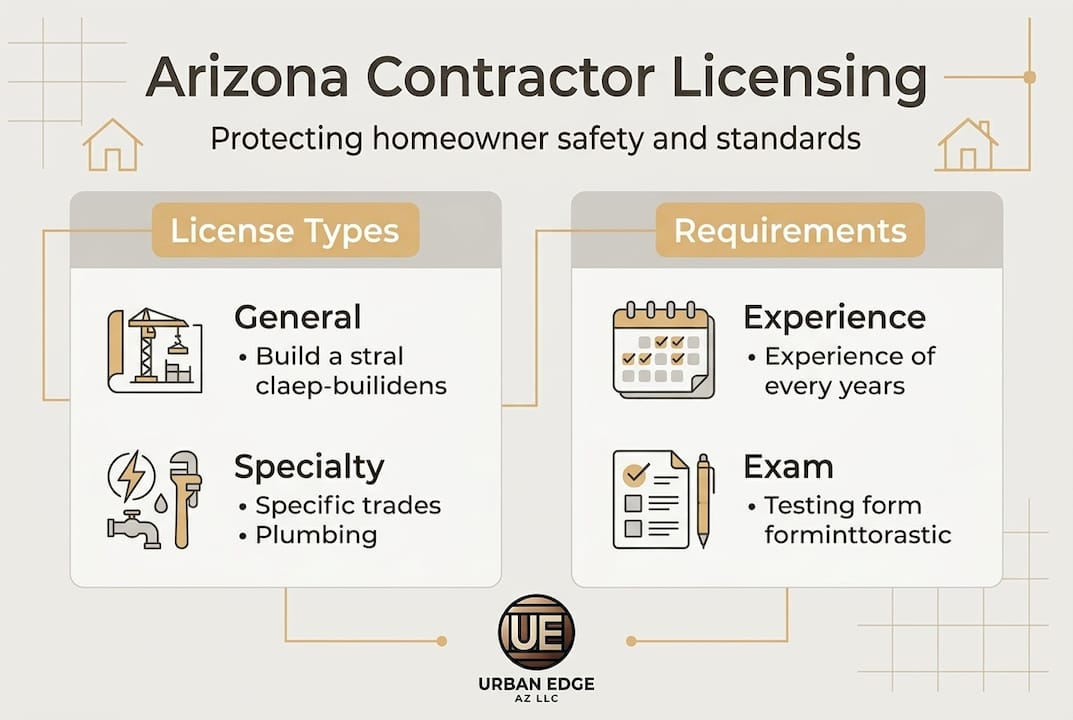
The ROC issues dozens of license classifications, but as a homeowner, a handful of them matter most to you. The broadest category is the General Residential Contractor, which falls under the B or R series of classifications. According to license classifications, the key license for residential projects is the General Residential Contractor (B or R-series), which allows construction and repair of residential structures like houses and appurtenances but requires subcontracting of electrical, plumbing, HVAC, pools, and similar work to specialty licensees.
That last part is critical and often misunderstood. A general residential contractor can manage and oversee your entire project, but they cannot personally perform the plumbing, electrical wiring, HVAC installation, or pool work themselves unless they also hold the corresponding specialty license. If a contractor tells you they can handle all of it under one license, that is a serious red flag you should not ignore.
| License type | What it covers | What requires a specialty sub |
|---|---|---|
| B-1 General Commercial | Commercial buildings and structures | Electrical, plumbing, HVAC |
| B-3 General Residential | Single-family homes, repairs, additions | Electrical, plumbing, HVAC, pools |
| R-series Residential | Specific residential categories | Varies by R classification |
| C-series Specialty | One trade only (e.g., C-11 electrical) | N/A, that trade is the specialty |
Why specialty licenses exist separately
Arizona separates general from specialty licenses for a practical reason. Electrical and plumbing work carry life-safety consequences. Faulty wiring causes fires. Incorrect gas lines cause explosions. The state decided long ago that these trades require separate, focused training and testing. A carpenter who is also a brilliant project manager still does not have the depth of knowledge to safely wire a breaker panel. Specialty licenses ensure that whoever touches that panel has demonstrated competence specifically in that trade.
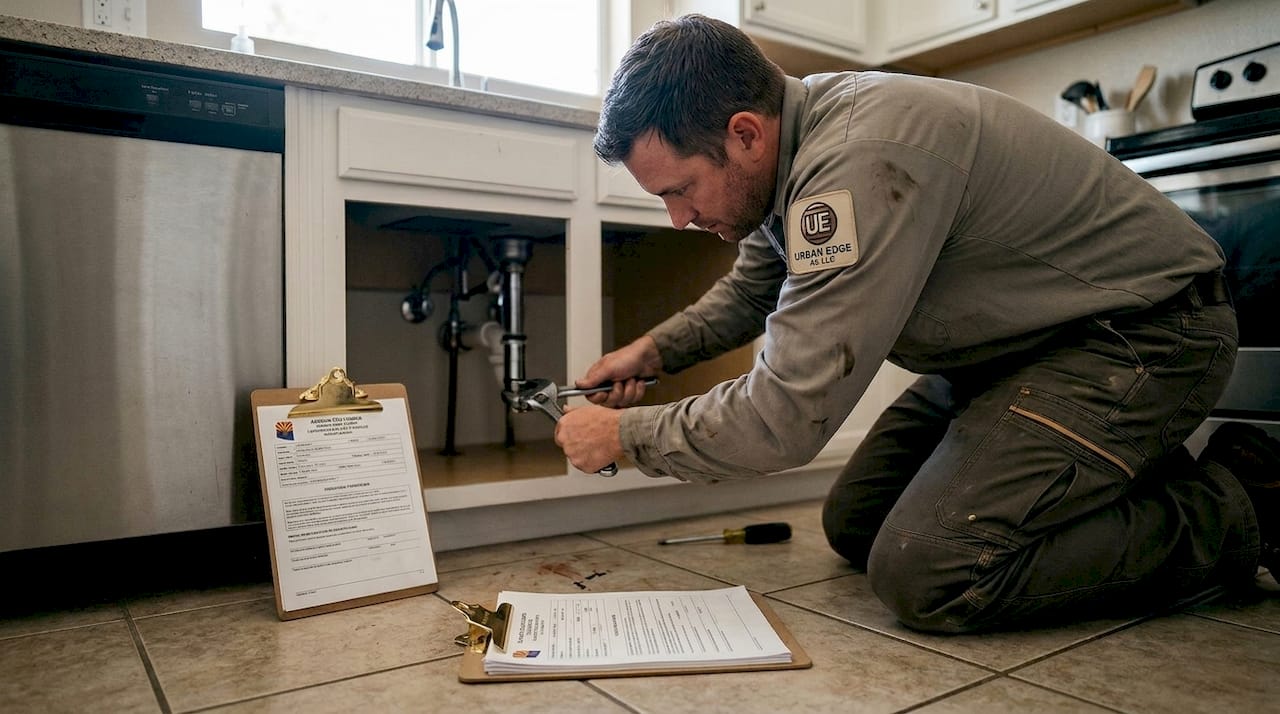
When your general contractor brings in a plumber, that plumber carries their own ROC license, their own bond, and their own insurance. Your project is covered at every level, not just at the top.
Pro Tip: Always ask your general contractor for the license numbers of every subcontractor they plan to use on your project, not just their own. You can verify each one individually through the ROC search tool to confirm active status and matching classification. Watch for contractor hiring red flags like vague answers about who performs specialty work.
Who qualifies for a contractor's license and how
Getting a contractor's license in Arizona is not simple, and that is intentional. The process weeds out unqualified operators before they can cause damage to your property or endanger your family. Understanding what a licensed contractor had to prove to earn that license tells you a great deal about the person standing in your living room.
The qualifying party requirement
Every licensed contractor in Arizona must have a designated "qualifying party." This is the individual whose experience, testing, and background check satisfy the ROC's requirements. In a one-person operation, the owner is usually the qualifying party. In larger firms, this can be a designated employee who meets all the criteria on behalf of the company. The qualifying party is legally tied to the license and is responsible for the quality and legality of all work performed under it.
AZ contractor license requirements specify that licensing requires a qualifying party with at least four years of practical or management experience, with up to two years of technical training creditable, plus passing trade and statutes and rules exams, a background check, bonds, and insurance.
That four-year experience threshold is meaningful. It filters out people who picked up a hammer last year and decided to call themselves a contractor. Management experience counts, but only up to a point. Someone who has spent years supervising crews but never built anything with their hands will need to document that supervisory work carefully, and the ROC scrutinizes those records.
The exam and background check process
The qualifying party must pass two separate exams. The first is a trade exam specific to the license classification they are seeking. A residential contractor exam tests knowledge of building codes, structural systems, safety standards, and construction practices. The second exam covers Arizona statutes and rules, meaning the contractor must understand the legal framework they operate within, including contractor law, consumer rights, and ROC regulations. Passing both exams proves not just technical skill but legal literacy.
The background check adds another layer of accountability. Contractors with serious criminal histories or patterns of financial fraud can be denied licensure. This protects you from hiring someone who has a documented history of taking deposits and disappearing.
Here is the sequential path every contractor takes to earn their Arizona license:
- Accumulate at least four years of documented experience in the relevant trade or management role
- Gather and submit documentation proving that experience (pay stubs, tax records, employer letters)
- Submit the license application and pay the applicable fees to the ROC
- Pass the trade-specific exam covering construction standards and codes
- Pass the Arizona statutes and rules exam covering contractor law
- Complete the background check and resolve any issues
- Obtain the required surety bond (minimum amounts vary by license type)
- Secure general liability insurance and workers' compensation if applicable
- Receive the license and maintain it through renewal cycles and continuing education
| Requirement | Details |
|---|---|
| Experience | Minimum 4 years; up to 2 years of technical training may substitute |
| Trade exam | Must pass with required minimum score |
| Statutes/rules exam | Must pass separately |
| Background check | State and federal review |
| Surety bond | Required; amount varies by license classification |
| Insurance | General liability; workers' comp if employees |
| Renewal | Required periodically; fees apply |
Pro Tip: When vetting a contractor, ask them directly who their qualifying party is and how their experience was documented for the ROC. A legitimate contractor will answer this without hesitation. If you are planning kitchen remodeling expertise, the qualifying party's background in residential renovation work specifically matters.
Why licensing matters for homeowners
You might be thinking that licensing is primarily a formality for contractors and that the real proof is in the finished work. That thinking has cost Arizona homeowners tens of thousands of dollars. Licensing creates a legal and financial safety net that exists specifically for you, and when you hire without it, that net disappears entirely.
The ROC Recovery Fund: your financial backstop
The ROC administers a Recovery Fund that is unique to residential construction. This fund exists to compensate homeowners who suffer financial losses because a licensed contractor performed defective, incomplete, or fraudulent work. If a licensed contractor abandons your project mid-build or causes significant damage, you can file a claim with the ROC and potentially receive compensation from this fund. As About ROC explains, the ROC emphasizes consumer protection via the Recovery Fund (unique to residential), but only for licensed contractors, so always verify to access those protections.
That "only for licensed contractors" condition changes everything. The Recovery Fund does not apply to unlicensed work. If someone without a license tears up your bathroom and walks away with your deposit, you have no access to that fund. Your only option is civil court, which is expensive, slow, and uncertain.
The complaint and resolution process
Beyond the Recovery Fund, the ROC provides a formal complaint and resolution process. If a licensed contractor does work that falls below code, refuses to finish a project, or uses materials different from what was agreed upon, you can file a complaint with the ROC. The agency investigates, can require the contractor to fix deficient work, and can suspend or revoke licenses for serious violations. This accountability structure simply does not exist for unlicensed operators.
Here are the key protections you get when you hire a licensed contractor:
- Bond coverage: The contractor's surety bond can pay for damages if they fail to complete work or cause financial harm
- Insurance protection: General liability insurance covers property damage or injuries that occur during the project
- ROC complaint filing: You have a formal channel to report problems and seek resolution
- Recovery Fund access: Financial compensation for losses caused by licensed contractors
- Legal standing: Licensed work creates a stronger paper trail for civil claims if needed
- Code compliance: Licensed contractors must follow building codes, protecting your home's structural integrity and resale value
What you lose by hiring unlicensed
Hiring an unlicensed contractor is not just a financial gamble. In Arizona, hiring someone without the proper license for jobs over $1,000 or for work that requires permits can expose you to fines and legal complications. Your homeowner's insurance policy may deny claims for damage caused by unlicensed work. The red flags of unlicensed contractors often appear subtle at first, like suspiciously low bids or reluctance to pull permits.
Know the legal requirements: Arizona law requires that any contract for residential work exceeding $1,000 must include the contractor's ROC license number. If a contractor offers you a written agreement without that number, do not sign it. Additionally, "job splitting" (breaking a project into segments under $1,000 to avoid licensing requirements) is illegal under Arizona law and carries its own penalties for the contractor. Per the AZ ROC License Search Guide, contracts over $1,000 must include the license number, and you should verify active status, matching classification, bond, and complaints before signing anything.
Working with licensed contractor advantages extends beyond legal compliance. Licensed contractors typically carry better materials, maintain professional relationships with reliable subcontractors, and understand permit processes that protect your home's value for future buyers.
How to check and verify a contractor's license
Knowing that licensing matters is only useful if you actually verify it. The good news is that Arizona makes this easy. The ROC provides a free, public search tool that anyone can use to check the status of any contractor license in the state in under two minutes.
Using the ROC search tool
The Arizona ROC's online search tool is available at azroc.my.site.com. You do not need an account. You do not need to pay anything. You can search by contractor name, company name, or license number. The results show you the license classification, current status, bond information, expiration date, and any complaints or disciplinary actions on record.
As the AZ ROC License Search Guide confirms, homeowners must verify licenses via ROC search and check active status, matching classification, bond, complaints, and expiration. Contracts over $1,000 must include the license number, so get it from the contractor before you search.
What to look for when you search
Finding a result is not enough. You need to read that result carefully. Here is what to check:
- Active status: The license should say "Active." Expired, suspended, or revoked licenses are disqualifying. Do not accept explanations like "it's just being renewed." Verify it yourself.
- Classification match: Confirm the license classification matches the work being performed. A C-series specialty license holder cannot do general residential contracting under that license.
- Bond status: Check that the bond is current. An expired bond means you may not have financial recourse if something goes wrong.
- Expiration date: A license expiring in two weeks is still technically active, but ask how the renewal is progressing before committing to a long project.
- Complaints history: Review any filed complaints and their outcomes. One old resolved complaint means something different from three recent unresolved ones.
- Business entity match: The company name on the license should match the company name on your contract. Mismatches can indicate someone operating under another contractor's license.
Common tricks and how to spot them
Some unscrupulous operators try to skirt the system. One common tactic is job splitting, which involves breaking a larger project into multiple smaller contracts, each under $1,000, to avoid the licensing requirement. Arizona contractor license reciprocity research confirms that job splitting to evade the $1,000 threshold is illegal, and informal experience is difficult to document for qualifying parties, with no broad reciprocity with other states. If someone proposes billing your project in unusual installments without clear explanation, ask why.
Another trick involves contractors who show you a license but are actually working outside their classification. A C-series tile contractor cannot legally serve as your general residential contractor. Always verify that the license type matches the full scope of what they are promising to do.
Pro Tip: Arizona does not have broad license reciprocity with other states. A contractor who was fully licensed in Nevada or California is not automatically legal to operate in Arizona. Always check their AZ ROC status directly, regardless of what credentials they show you from elsewhere. When hiring remodeling professionals, this out-of-state credential issue comes up surprisingly often in the West Valley, where many contractors relocate from other states.
What most homeowners miss: the real risks and realities
Here is an uncomfortable truth that most licensing guides will not tell you directly. The biggest risk is not the obvious unlicensed guy handing out flyers at a hardware store. It is the contractor your neighbor referred, the one who has done three projects on your street, the one who talks fluently about permits and codes, but whose license either lapsed six months ago or was never appropriate for the scope of your project.
Personal referrals create a false sense of security. Your neighbor had a great experience with a deck build. That does not mean the same contractor is qualified to manage a full kitchen gut-and-rebuild with structural changes. The ROC classification system exists precisely because competence in one area does not transfer automatically to another.
Handypeople and DIY-adjacent workers fall into a similar trap. Someone who has spent twenty years fixing their own homes and their friends' homes has genuine experience, but that experience almost certainly does not meet the ROC's documentation requirements for the qualifying party process. Informal experience is hard to document, and the ROC requires documented proof, not just a good story.
There is also an insurance angle that most homeowners overlook entirely. If an unlicensed worker is injured on your property, your homeowner's insurance may not cover the liability. If that worker's unlicensed renovation causes a fire or water damage, your insurer may deny the claim because the work was not performed in compliance with state law. You could end up personally liable for a situation you thought was covered.
The ROC licensing system exists because construction problems are genuinely common, not because the state wants to add bureaucracy. Every requirement, from the four-year experience threshold to the trade exams to the bonding requirement, was added because real homeowners suffered real losses that those requirements now prevent. Respect those guardrails by checking risks when hiring before you commit to anyone.
Verify everyone. Not just the person handing you a business card, but every subcontractor who steps onto your property. Your general contractor is responsible for ensuring their subs are properly licensed, but the final accountability for who you allow on your property rests with you.
Partner with trusted, licensed professionals for peace of mind
All of this research and verification is important, and it is also a lot to manage on top of planning a major construction or remodeling project. The simplest way to eliminate most of this risk is to hire a general contractor who has already built a vetted network of licensed subcontractors and can document everything before you sign.

Urban Edge AZ LLC brings fully verified licensed general contracting to homeowners throughout Buckeye, Goodyear, and Phoenix. Every project we manage operates under a valid ROC license with properly credentialed subcontractors for every specialty trade. Whether you are planning a custom home build or working through the details of a kitchen remodeling project, we handle the licensing compliance, permit pulling, and coordination so you can focus on the decisions that actually matter to your family. Reach out today to schedule your consultation and get a clear project estimate.
Frequently asked questions
What type of contractor license is needed for a home remodel in Arizona?
A General Residential Contractor license (B-3 or R-series) covers remodeling or repair work, but specialty work like plumbing or electrical must be performed by subcontractors holding their own specialty license. The license classifications page confirms that general residential licenses require subcontracting of electrical, plumbing, HVAC, and pool work to specialty licensees.
How do I check if a contractor's license is valid in Arizona?
You can verify a contractor's license status, classification, and complaint history using the Arizona Registrar of Contractors' free online search tool. Per the AZ ROC License Search Guide, check for active status, matching classification, current bond, any complaints, and expiration date before signing any agreement.
Is it illegal to hire an unlicensed contractor in Arizona?
Yes, for jobs over $1,000 or any work requiring permits, hiring an unlicensed contractor puts you at legal and financial risk. The About ROC resource confirms that the Recovery Fund is only available for work performed by licensed contractors, and the AZ ROC License Search Guide notes that contracts over $1,000 must include the contractor's license number.
Does out-of-state contractor experience count toward Arizona licensing?
Arizona does not broadly recognize out-of-state licenses, and informal or undocumented experience rarely qualifies for credit toward a new license. As AZ contractor license reciprocity data confirms, there is no broad reciprocity with other states, so always verify any contractor's current Arizona ROC status directly.