
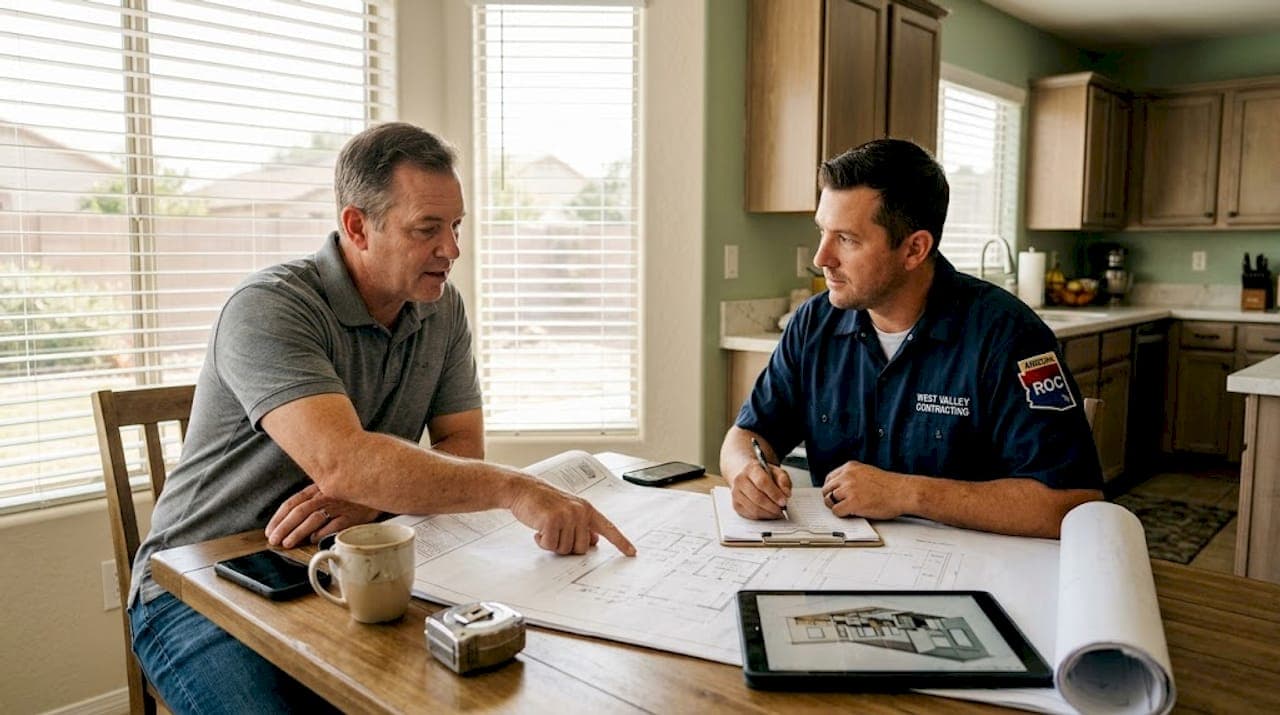
Most homeowners assume design and construction are two separate worlds that must stay apart. They hire an architect, wait months for drawings, then send plans out for bids, then manage two or three separate contracts while problems bounce between teams. But design-build is a delivery method where one team handles both design and construction under a single contract, and it can finish projects up to 100% faster than traditional methods. This guide breaks down exactly how the process works, what it means for West Valley homeowners in Buckeye, Goodyear, and Phoenix, and how to decide whether it fits your next remodel.
Table of Contents
- What is the design-build process?
- The design-build process: Step-by-step phases
- Benefits and drawbacks for Arizona homeowners
- When is design-build the best choice?
- A contractor's perspective: What most guides don't tell you
- Ready for a smoother remodel? Discover your design-build options
- Frequently asked questions
Key Takeaways
| Point | Details |
|---|---|
| Single team advantage | With design-build, one team handles design and construction, making communication smoother and projects faster. |
| Faster, clearer process | Design-build projects can finish up to twice as quickly as traditional methods with fewer surprises along the way. |
| Best for complex remodels | The design-build model is ideal for additions, major renovations, and jobs involving permits or structural work. |
| Know the risks | Design-build requires trusting a single firm, so quality and clear contracts are crucial for success. |
What is the design-build process?
At its core, design-build means one firm takes responsibility for everything. The same team that draws your floor plan also pulls the permits, orders materials, and swings the hammer. There is no gap between what the designer imagined and what the builder actually delivers, because they are the same people.
The traditional alternative is called design-bid-build, or DBB. In that model, you hire an architect separately, finalize plans, then send those plans to multiple contractors for competitive bids. It sounds logical, but it creates a gap. When something goes wrong, the architect points at the contractor and the contractor points at the architect. You are stuck in the middle.
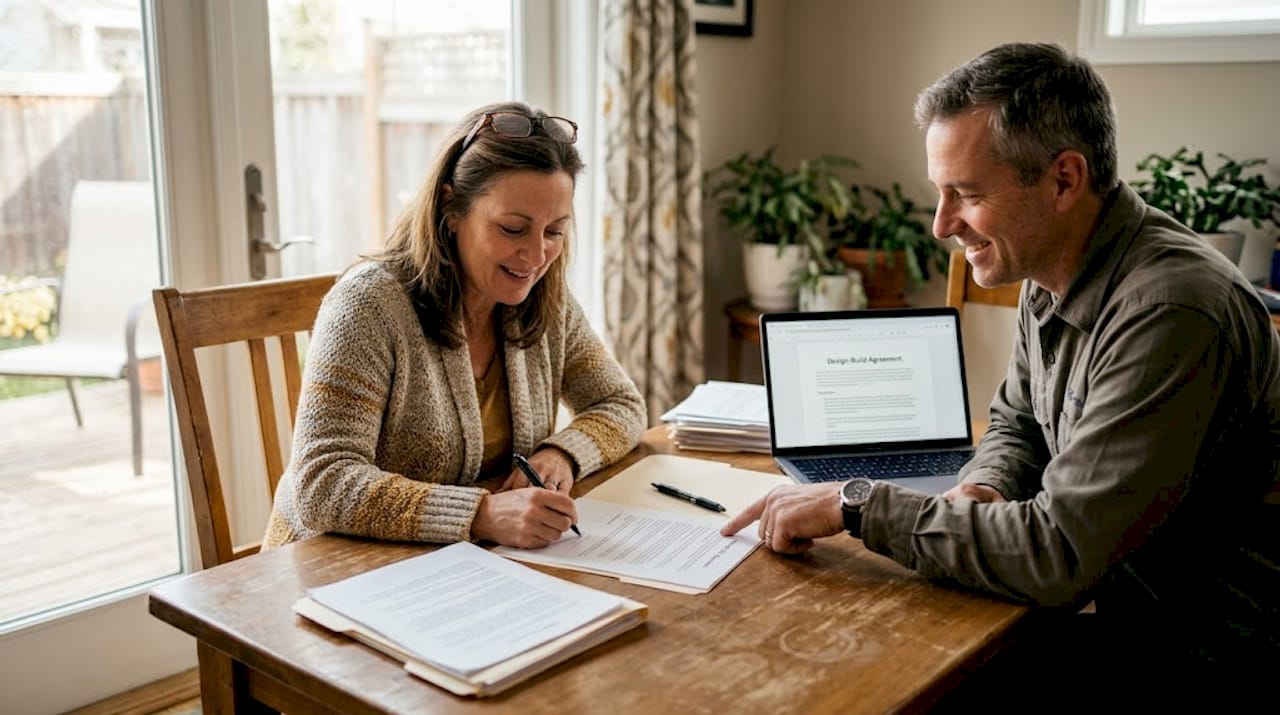
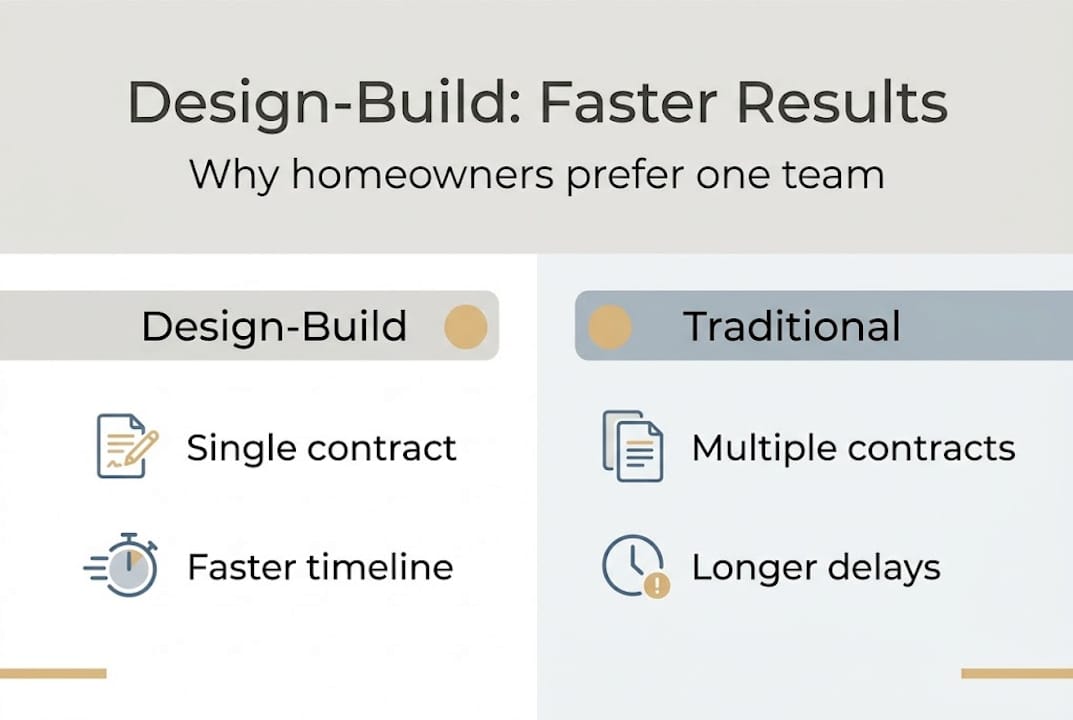
Design-build uses a single contract and a single point of responsibility, eliminating that finger-pointing problem entirely. If a detail on the drawing does not match what is buildable, the team catches it internally before it costs you money.
Here is a quick comparison:
| Feature | Design-build | Design-bid-build |
|---|---|---|
| Number of contracts | One | Two or more |
| Point of responsibility | Single firm | Split between designer and contractor |
| Communication | Internal | Across separate companies |
| Timeline | Overlapping phases | Sequential phases |
| Cost certainty | Higher | Lower |
| Change order risk | Lower | Higher |
Key differences worth knowing:
- Accountability: One team owns the outcome from sketch to final walkthrough.
- Speed: Phases overlap instead of waiting for one to fully finish before the next starts.
- Budget control: Cost input happens during design, not after plans are locked.
- Communication: No translation layer between what is designed and what is built.
Design-build projects complete 33 to 102% faster than traditional design-bid-build projects. For a West Valley homeowner who wants to add a bedroom before summer heat arrives, that speed difference is not a small detail. It is the difference between finishing in spring or finishing in fall. If you want to explore what this looks like in practice, general contracting services built around the design-build model are worth understanding before you commit to any method.
The design-build process: Step-by-step phases
Knowing the definition is useful. Knowing what actually happens week by week is what helps you plan your life around a remodel.
A typical residential design-build project involves 5 to 9 overlapping phases, with planning and design alone lasting 6 to 10 weeks. Here is what those phases look like:
- Initial consultation: You meet with the team, share your goals, and get a realistic picture of scope and budget. This is where good firms ask hard questions about how you actually use your space.
- Feasibility and planning: The team assesses your site, checks zoning and HOA rules, and confirms what is structurally possible. In the West Valley, this often includes soil evaluation for expansive clay conditions.
- Design development: Drawings, 3D renderings, and material selections happen here. Critically, the builder is in the room during design, so cost reality checks happen in real time.
- Material selection and specification: Finishes, fixtures, and structural materials are locked in. This step overlaps with design in a true design-build model.
- Permitting: Plans go to the city or county. Arizona permit timelines vary by municipality, so local experience matters here.
- Construction: Work begins. Because design is already fully coordinated, surprises are rare.
- Final walkthrough and post-build: Punch list items are resolved, warranties are issued, and the project is handed off.
| Phase | Typical duration |
|---|---|
| Consultation and planning | 1 to 2 weeks |
| Design development | 4 to 8 weeks |
| Material selection | 2 to 4 weeks (overlaps design) |
| Permitting | 2 to 6 weeks |
| Construction | Varies by scope |
| Final walkthrough | 1 to 2 weeks |
Pro Tip: During the design phase, ask your team to provide real-time cost input as each design decision is made. This prevents the painful moment where you fall in love with a layout only to find out it is $40,000 over budget.
Benefits and drawbacks for Arizona homeowners
Now that you understand the steps, the real question is whether this model works for your situation in the West Valley.
Main benefits:
- Faster completion: Overlapping phases cut weeks or months off your timeline.
- Fewer change orders: Design and construction coordination catches conflicts early.
- Single point of contact: You make one call instead of managing multiple vendors.
- Budget predictability: Cost input during design means fewer surprises mid-project.
- Accountability: No one can pass blame to another firm when something goes wrong.
Design-build also delivers lower cost growth and fewer change orders, which is especially valuable when structural work or desert site conditions are involved. West Valley soils in areas like Buckeye can shift seasonally, and a team that designs and builds together is better positioned to account for that from day one.
Nearly 50% of US construction spending is projected to use design-build by 2028, reflecting a broad industry shift toward integrated project delivery.
Potential drawbacks to consider:
- Less independent design oversight: You do not have a separate architect checking the contractor's work.
- Decision fatigue: You make many choices quickly during the design phase. It can feel overwhelming.
- Quality depends entirely on the firm: Choosing the wrong team means both your design and your construction suffer.
For West Valley homeowners specifically, HOA approval requirements in communities across Goodyear and Peoria add a layer that some firms handle better than others. Climate considerations also matter. Arizona's monsoon season and extreme summer heat require specific material choices and HVAC sizing that a locally experienced team will already know. Exploring remodel benefits with a firm that knows your zip code is a real advantage.
Pro Tip: Once design is finalized, insist on a fixed-price contract before construction begins. This protects you from cost creep and gives you a clear number to plan around.
When is design-build the best choice?
Design-build is not the right answer for every project. Knowing when it fits and when it does not will save you time and money.
Projects that benefit most from design-build:
- Kitchen remodels involving structural wall removal
- Room additions or second-story additions
- Full home renovations with multiple trades involved
- ADU (accessory dwelling unit) construction
- Projects requiring significant site preparation or grading
Design-build works best for complex remodels but may not be the right fit for simple cosmetic projects. If you are replacing cabinet doors and painting walls, you probably do not need an integrated design-build team. A handyman or a single trade contractor may be faster and cheaper.
When traditional design-bid-build might make more sense:
- Simple, clearly defined jobs where competitive bidding saves money
- Projects where you already have finalized architectural drawings
- Situations where you want an independent architect to check contractor work
Arizona adds specific layers to this decision. Permit requirements vary between Phoenix, Goodyear, and Buckeye. HVAC sizing must meet local energy codes. Expansive soils in parts of the West Valley require engineered foundations that need to be planned during design, not discovered during construction.
Three questions to help you choose the right method:
- Is my project structurally complex, or does it involve multiple trades working together?
- Do I want one team to own the outcome, or am I comfortable managing separate contracts?
- Is my timeline tight enough that overlapping design and construction phases would matter?
If you answered yes to all three, design-build is likely your best path forward.
A contractor's perspective: What most guides don't tell you
Here is the honest truth we share with neighbors and clients across the West Valley. The biggest advantage of design-build is not speed. It is fewer stressful surprises for you as a homeowner.
Most remodel horror stories start with a gap between what was designed and what was built, or a change order that appears after demolition begins. Design-build closes that gap structurally, but only if you choose the right firm. Single-point accountability only works when the firm you hire actually has strong design and construction capabilities under one roof. A contractor who added an interior designer to their website last year is not the same as a team with integrated experience.
In the West Valley, watch for three things before signing anything. First, verify ROC (Registrar of Contractors) licensing for Arizona. Second, ask for references from projects completed within the last 12 months in your specific city. Third, ask how they handle HOA submittals and whether they have relationships with local permit offices. These details separate firms that know the region from those who are learning on your dime. For more on what to expect from a local builder, our Arizona general contractor insights cover the specifics worth knowing.
Pro Tip: Always verify ROC licensing directly on the Arizona ROC website before signing a contract. It takes two minutes and protects you from significant risk.
Ready for a smoother remodel? Discover your design-build options
If this process sounds like it could simplify your next project, you are not alone. West Valley homeowners are choosing integrated design-build teams because they want fewer headaches, not more meetings.
At Urban Edge AZ LLC, we work with homeowners across Buckeye, Goodyear, and Phoenix who want one team to manage everything from the first sketch to the final inspection. We understand local soil conditions, HOA requirements, permit timelines, and Arizona's climate demands. Whether you are planning a kitchen remodel, a room addition, or a full renovation, the Urban Edge LLC design-build experts are ready to walk you through your options and build a plan that fits your budget and timeline.
Frequently asked questions
How does design-build reduce project length compared to traditional methods?
Design-build overlaps phases and keeps one team managing both design and construction, which eliminates the waiting periods between stages. Projects complete 33 to 102% faster than traditional design-bid-build.
What are the main risks of using design-build for a home remodel?
The primary risk is reduced independent oversight, since you rely on one firm for both design quality and construction quality. Less design oversight is a real tradeoff that makes choosing the right firm critical.
Does design-build work for small remodeling projects?
For straightforward cosmetic updates, traditional design-bid-build may be more cost-effective because competitive bidding can lower costs. Simple cosmetic remodels often do not justify the integrated team structure.
What makes design-build popular in Arizona's West Valley?
The West Valley's combination of desert soils, HOA communities, and local permit complexity makes integrated project delivery especially efficient. Design-build suits desert soil and site-specific prep far better than sequential methods where issues surface late in the process.