
TL;DR:
- Hiring a licensed contractor with proper credentials protects your project from legal and quality issues.
- Detailed scopes, milestone payments, and thorough documentation safeguard homeowners during remodeling projects.
- Proper planning, contractor vetting, and dispute resolution ensure successful, on-budget home renovations.
Starting a home renovation or new build in the West Valley without proper preparation is one of the fastest ways to lose money. Arizona homeowners regularly run into budget overruns, permit delays, and contractor disputes that could have been avoided with the right information up front. Between Buckeye, Goodyear, and Phoenix, there are thousands of contractors competing for your business, and not all of them are qualified, licensed, or even honest. This guide walks you through every critical step, from verifying contractor credentials to managing your project on-site and resolving disputes, so you can protect your investment and get the results you actually want.
Table of Contents
- Understanding Arizona's contractor licensing and requirements
- Planning your project: Scope, budget, and finding reputable contractors
- Key steps in managing the construction or remodel process
- Troubleshooting, dispute resolution, and ensuring quality results
- A seasoned contractor's take: What most homeowners miss
- How Urban Edge LLC can simplify your next project
- Frequently asked questions
Key Takeaways
| Point | Details |
|---|---|
| Verify contractor licensing | Always check that any contractor you hire is licensed, bonded, and insured per Arizona law. |
| Plan with contingencies | Include a 10-20 percent contingency in your budget to handle surprises and avoid overruns. |
| Use milestone payments | Break payments into project milestones for better oversight and protection. |
| Document everything | Keep thorough records and insist on a detailed contract to prevent disputes. |
| Know your dispute options | Use the ROC recovery fund and legal recourse if issues arise with licensed contractors. |
Understanding Arizona's contractor licensing and requirements
The moment you decide to hire someone for a significant home improvement project, you're entering a legally regulated space. Arizona has strict rules about who can perform construction work, and understanding those rules is your first line of defense against fraud, shoddy work, and costly legal problems.
Who needs a license and when
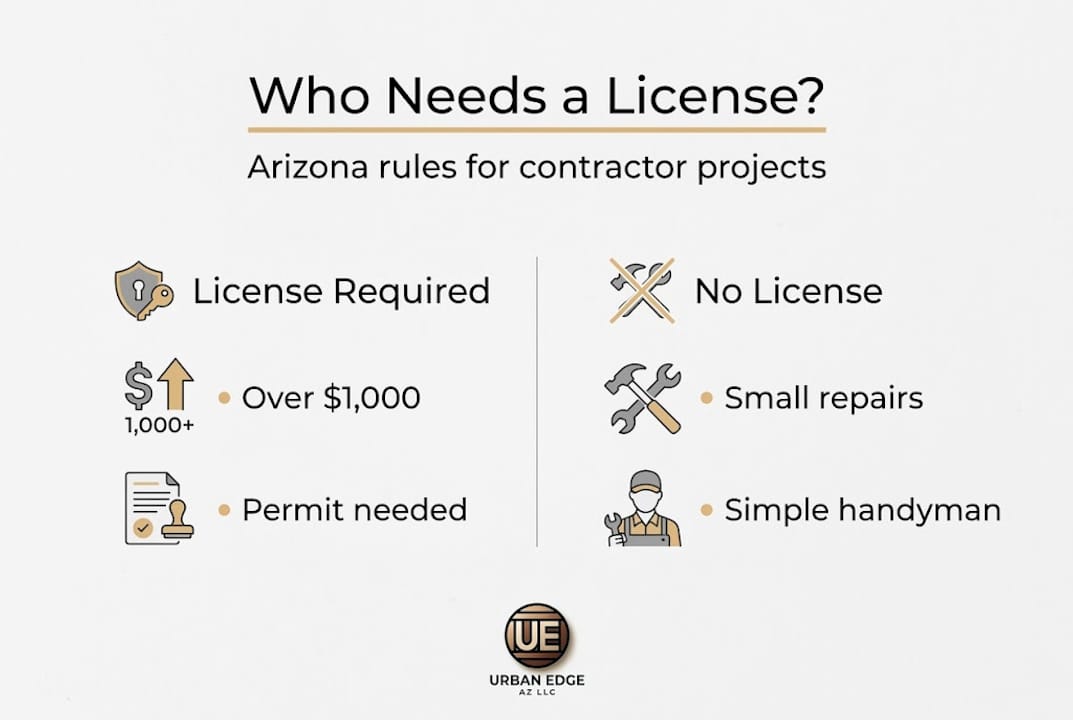
In Arizona, residential work over $1,000 in combined labor and materials, or any project that requires a permit, legally requires the contractor to be licensed by the Arizona Registrar of Contractors (ROC). For residential projects, this means the contractor must hold a Residential General (C-1) license at minimum. This isn't a technicality. It's the law, and violating it can leave both the contractor and the homeowner exposed.
Many homeowners assume that small jobs or "handyman" work fall under the radar. Some do. But the moment your project involves structural changes, electrical, plumbing, or anything that requires an inspection, you need a licensed professional on the job. The C-1 license specifically covers residential general contracting, meaning the contractor can oversee and coordinate work across multiple trades within a home construction or remodel project.
What qualifications a licensed contractor must have
Arizona doesn't hand out licenses easily. To qualify as a Residential General contractor, the qualifying party must have at least four years of verifiable trade experience within the last ten years. They must also pass both a trade exam and a business management exam, post a surety bond of $9,000 or more for residential general work, carry liability insurance, and clear a background check.
That's a significant bar. The bond and insurance requirements alone separate the professionals from the fly-by-night operators who show up with a truck and a promise. When something goes wrong on your job, which does happen even with good contractors, that bond and insurance are what protect you from paying out of pocket for someone else's mistake.
Here's a quick breakdown of what a C-1 licensed contractor must have:
- Minimum four years of verifiable trade experience in the last decade
- Passing scores on both trade and business/law examinations
- Surety bond of at least $9,000
- Active general liability insurance
- Clean background check
- Active ROC license in good standing
What to ask before signing anything
Before you write a single check, request the contractor's ROC license number and verify it yourself at the ROC website. You want to see an active license, no disciplinary actions, and a current bond and insurance on file. Also ask for a copy of their liability insurance certificate and request to be listed as an additional insured on the policy for the duration of the project.
Pro Tip: Don't just take a contractor's word for their license status. Go directly to the Arizona ROC website and search by name or license number. A quick two-minute search can save you from a nightmare. You can also see if any complaints have been filed against them, which tells you a lot about how they handle problems.
Understanding licensed contractor qualifications is especially important when you're planning a significant kitchen or bathroom remodel, where multiple trades are involved and the work is heavily inspected. And if you're comparing contractors and want to understand the broader AZ general contracting requirements, start with the ROC's license classification page before you accept any bids.
| Requirement | Details |
|---|---|
| License type for homes | Residential General (C-1) |
| Minimum experience | 4 years verifiable in last 10 years |
| Exams required | Trade exam + business/law exam |
| Surety bond minimum | $9,000 for residential general |
| Insurance required | General liability (active) |
| Background check | Required for qualifying party |
Planning your project: Scope, budget, and finding reputable contractors
With licensing and qualifications clarified, your next priority is careful project planning and contractor selection. Skipping this phase or rushing through it is where most West Valley homeowners get into trouble.
Defining your project scope
Before you contact a single contractor, write down exactly what you want. This is called defining your project scope, and the more detailed it is, the better. Your scope should include every room or area affected, the specific work to be done, materials you want or expect, and any design preferences. Vague scopes lead to change orders, and change orders are one of the most common ways projects go over budget.
A change order is a formal request to modify the original contract, usually involving extra cost and time. If your contract scope is fuzzy, a contractor has room to interpret it in ways that benefit them, not you. "Update the kitchen" means something very different to a homeowner picturing custom cabinets and quartz countertops versus a contractor planning builder-grade laminate.
Building a realistic budget with contingency
Here's a number every Arizona homeowner should know: 60% of residential projects go over budget without a contingency fund. That's not a rare edge case. It's the majority. Material prices fluctuate, unexpected structural issues surface once walls open up, and permit requirements occasionally add scope.

The standard advice from experienced contractors is to add 10 to 20 percent on top of your base estimate as a contingency. On a $50,000 kitchen remodel, that means setting aside $55,000 to $60,000 in accessible funds. Don't think of the contingency as money you'll spend. Think of it as money you're not surprised to spend if something unexpected comes up.
Vetting contractors the right way
Finding reputable contractors in the West Valley takes more than a Google search. Here's a numbered process that works:
- Collect at least three bids from licensed, ROC-verified contractors.
- Ask each contractor for references from projects completed in the last 12 months.
- Call those references and ask specifically about timelines, communication, and whether the final cost matched the original estimate.
- Search the ROC database for complaints or disciplinary actions on each contractor.
- Visit at least one completed project in person if possible.
- Check online reviews on Google and the Better Business Bureau, looking for patterns rather than single incidents.
- Ask each contractor for a sample contract before you commit to anything.
The comparison between a thoroughly vetted bid and a suspiciously low bid deserves its own breakdown:
| Factor | Vetted contractor bid | Low-ball bid |
|---|---|---|
| License status | Active, verified ROC license | Often unlicensed or lapsed |
| Bid detail | Itemized with material specs | Vague, round numbers |
| References | Recent, verifiable, available | Few or unavailable |
| Contract quality | Detailed with scope and schedule | Minimal or verbal |
| Insurance | Provided certificate on request | Claims to have it, can't prove it |
| Payment terms | Milestone-based, reasonable deposits | Requests large upfront cash payment |
Knowing the red flags when hiring a contractor in Arizona can save you from making a decision you'll regret. And once you're in the remodeling project planning stage, having a clear scope and a vetted contractor list makes the whole process move faster and more predictably.
Milestone payments: Your financial safety net
Never pay a contractor the full amount up front. Structure your payments around project milestones: a reasonable deposit to start (typically 10 to 15 percent), then payments tied to specific, verifiable stages of completion. Framing complete, rough plumbing inspection passed, drywall hung, and final walkthrough approved are all examples of milestones that should trigger payment. This keeps your contractor motivated and gives you leverage if work stalls or quality drops.
Key steps in managing the construction or remodel process
Once you've found your contractor, you need a clear game plan to oversee your project's execution. Signing the contract is just the beginning.
Step-by-step project management
- Finalize your contract. Make sure it includes a detailed scope of work, material specifications, start and end dates, the full payment schedule tied to milestones, and a process for handling change orders.
- Confirm all required permits are pulled. Your contractor should pull permits before any work begins. Ask to see them. Permits ensure your project is inspected by the city or county and meets local building codes.
- Set a communication schedule. Agree on daily or weekly check-ins, whether by phone, text, or in-person walk-throughs. Decide early how decisions and approvals will be documented.
- Photograph everything. Before work starts, photograph existing conditions. Continue photographing during demolition, framing, rough-in work (plumbing, electrical, HVAC), and at each milestone. These photos protect you if a dispute arises later.
- Review each milestone before paying. Don't release payment for a completed milestone until you've verified the work yourself and, where applicable, received a passing inspection report.
- Document change orders in writing. Any deviation from the original scope, no matter how small, should be written up, priced, and signed by both parties before the work happens.
- Conduct a final walkthrough with your contractor. Create a punch list of any incomplete or unsatisfactory items and get a written commitment on when and how they'll be resolved before the final payment clears.
Safety notice: Working with unlicensed contractors on permitted work is more than just risky. It's illegal in Arizona and can result in stop-work orders, fines, forced demolition of completed work, and denial of insurance claims if something goes wrong on the job site. Unlicensed workers also typically carry no liability insurance, which means any injury or property damage during your project becomes your financial responsibility.
Keeping project records
Set up a simple folder system, either physical or digital, for your project. Keep copies of the signed contract, all permits, all inspection reports, all change orders, all payment receipts, and all written communications with your contractor. If a dispute ever goes to the ROC or a court, whoever has better documentation almost always wins.
Pro Tip: Save every text message and email from your contractor. Even casual conversations about scheduling or material choices can become important evidence if something goes sideways. If a significant decision is made verbally on-site, follow up with a quick text or email summarizing what was agreed. This creates a paper trail without being confrontational.
Milestone payments protect homeowners by tying financial leverage to project progress. If you encounter problems during execution, being aware of the warning signs during construction gives you the context to act fast before issues compound.
Troubleshooting, dispute resolution, and ensuring quality results
Even with the best planning, challenges and disputes may arise. Here's how to handle them and ensure quality at every stage of your project.
Common problems and why they happen
Delays are the most frequent complaint West Valley homeowners have about contractors. Sometimes delays are legitimate, material backorders, inspection scheduling, weather. But sometimes they signal poor project management, crew shortages, or a contractor who took on too much work. Knowing the difference requires direct, documented communication.
Shortcuts are harder to spot but more damaging. A contractor who installs substandard underlayment beneath your new tile floor isn't going to announce it. That's why your milestone inspections and photographs matter so much. Quality problems discovered after final payment is released are significantly harder to resolve.
Dispute resolution: Your options
When a dispute arises with a licensed contractor in Arizona, you have real options. Here's how to use them:
- Direct communication first. Put your concern in writing, clearly describe the problem, reference the specific contract language that applies, and propose a resolution. Give the contractor a reasonable deadline to respond.
- ROC complaint. If direct communication fails, file a complaint with the Arizona ROC. The ROC investigates complaints against licensed contractors and can mandate corrective work.
- ROC recovery fund. Arizona's ROC recovery fund exists specifically to compensate homeowners who suffer financial losses due to the conduct of a licensed contractor. This is one of the most important reasons to hire licensed contractors.
- Legal action. For significant disputes involving large sums, consulting a construction attorney may be warranted. This is typically a last resort but is sometimes necessary.
| Resolution method | Best used when | Timeframe |
|---|---|---|
| Direct communication | Minor issues, first occurrence | Days to weeks |
| ROC complaint | Work not corrected, repeated issues | Weeks to months |
| ROC recovery fund | Financial loss from licensed contractor | Months |
| Legal action (attorney) | Large claims, fraud, serious breach | Months to over a year |
Quality checkpoints before final payment
Never release your final payment until you've completed a thorough final walkthrough. Here's what to check:
- All contracted work is complete per the original scope and all signed change orders
- Every permit has a passing final inspection stamp
- All materials match what was specified in the contract
- Surfaces, fixtures, and finishes are free of damage, defects, and incomplete finishing
- All debris and equipment are removed from the property
- Manuals, warranties, and documentation for any installed equipment are handed over
- The contractor has provided written warranty information for their labor
Recognizing contractor dispute signs early gives you the best chance of resolving problems before they escalate to formal complaints or legal action. Keep your documentation current right up to the moment you release that final check.
A seasoned contractor's take: What most homeowners miss
Having looked at the hands-on steps, here's what experienced Arizona contractors see time and again, and what most homeowners never anticipate until it's too late.
The single biggest mistake isn't hiring the wrong contractor. It's not getting a detailed enough contract. Homeowners assume that a professional contractor will automatically know what "renovate the master bathroom" means to them. They won't. Every homeowner has a different vision, and without a written scope that specifies tile size, grout color, fixture brands, and layout details, that vision stays entirely in your head. The contractor builds to a standard that satisfies them, not necessarily you.
Low bids are seductive, especially on larger projects. We've seen homeowners in the Goodyear and Buckeye areas choose bids that were 30 to 40 percent below the next lowest competitor, only to face abandoned projects, substandard materials, or demands for additional payment mid-project. A bid that's dramatically lower than others isn't a deal. It's a signal that something is missing: experience, proper licensing, adequate insurance, quality materials, or realistic scheduling.
Rushing timelines is another trap. If your contractor promises to complete a full kitchen remodel in two weeks, that's a red flag, not a selling point. Proper work takes time, inspections take time, and materials need to be ordered, delivered, and acclimated. Contractors who rush are the same ones who skip inspections and cut corners on structural elements you'll never see until something fails.
Smart homeowners protect themselves by structuring payments carefully and keeping thorough documentation throughout. They also call references themselves rather than just reading a contractor's provided list of glowing reviews. When you call a reference, ask pointed questions: Did the project finish on time? Did the final cost match the original estimate? Would you hire this contractor again without hesitation?
"The contractors we work with who have the fewest disputes are the ones who overcommunicate. They respond to calls and texts quickly, they flag problems early, and they document everything in writing. A contractor who goes quiet when things get difficult is your earliest warning sign."
The lessons learned from looking at real red flags in Arizona consistently point back to one theme: the homeowners who had the best outcomes were the ones who stayed engaged, kept records, and never paid ahead of completed, verified work.
How Urban Edge LLC can simplify your next project
For homeowners who want expert guidance at every stage, here's how Urban Edge can help.
Navigating Arizona's licensing rules, vetting contractors, managing timelines, and protecting your budget is genuinely complex work. The Arizona general contracting experts at Urban Edge AZ LLC have built their reputation across Buckeye, Goodyear, and Phoenix by doing exactly what this guide describes, only so you don't have to do it alone.

From full kitchen remodeling solutions to custom new builds and day-to-day handyman services, Urban Edge handles every phase of your project with transparent pricing, milestone-based payment structures, and warranty-backed workmanship. Every project goes through proper permitting, licensed tradespeople, and dedicated project management from start to finish. Before your next renovation, read the hiring red flags guide on our site, then contact us for a free consultation and a realistic cost estimate built around your actual goals.
Frequently asked questions
Do I always need to hire a licensed general contractor in Arizona?
Yes. For any residential project over $1,000 in combined labor and materials, or any project requiring a permit, Arizona law requires a licensed contractor with an active ROC license.
What is the minimum experience required to become a licensed general contractor in Arizona?
The qualifying party needs at least four years of verifiable trade experience within the last ten years, along with passing trade and business exams, a surety bond, liability insurance, and a cleared background check.
How can I protect my home investment during a remodel?
Hire a licensed, ROC-verified contractor, use detailed contracts with itemized scopes, set up milestone payments rather than paying in full up front, and keep organized documentation of every stage.
What should I do if there's a dispute with my general contractor?
Start with direct written communication, then file a complaint with the Arizona ROC if unresolved. The ROC recovery fund is available to compensate homeowners who suffer financial losses from licensed contractor misconduct.