

TL;DR:
- Verify Arizona ROC license status and complaint history before hiring a contractor.
- Always get a detailed written contract with scope, timeline, and milestone payments.
- Use Arizona's complaint process and Recovery Fund if disputes or poor work occur.
Hiring the wrong general contractor in the West Valley can cost you far more than just money. Imagine signing a deal with someone who seemed professional, collecting a large deposit, and then watching your kitchen remodel stall out halfway through while calls go unanswered. This situation is more common than most homeowners realize, and it happens precisely because the hiring process gets rushed. Arizona gives you real, legal tools to protect yourself, but only if you use them before a dispute starts. This guide walks you through every critical step so you hire with confidence, avoid scams, and know exactly what to do if something goes sideways.
Table of Contents
- What to know before you hire: Arizona's contractor rules and homeowner protections
- Step-by-step: How to find and vet general contractors in the West Valley
- The contract essentials: Payment, change orders, and documentation
- Resolving problems: What to do if things go wrong
- The realities of hiring: What most guides don't tell Arizona homeowners
- Connect with trusted Arizona contractors
- Frequently asked questions
Key Takeaways
| Point | Details |
|---|---|
| Verify ROC licensing | Always check your contractor’s Arizona Registrar of Contractors license and complaint history for peace of mind. |
| Demand written contracts | Protect yourself with clear contracts that define scope, milestones, payments, and changes. |
| Watch for red flags | Avoid contractors who pressure for quick deals, refuse documentation, or offer vague terms. |
| Use Arizona’s remedies | If there’s a problem, use the ROC complaint process and Recovery Fund before turning to litigation. |
What to know before you hire: Arizona's contractor rules and homeowner protections
Before you start searching for contractors, it's vital to understand the protections Arizona law provides and the potential risks of skipping official steps.
Arizona has one of the more structured contractor licensing systems in the country. Every general contractor who performs residential work in the state must hold an active license issued by the Arizona Registrar of Contractors, commonly known as the ROC. This is not optional, and it is not just a formality. The ROC licensing requirement exists specifically to protect homeowners from unqualified workers who take money without the training, insurance, or accountability to finish a job properly.
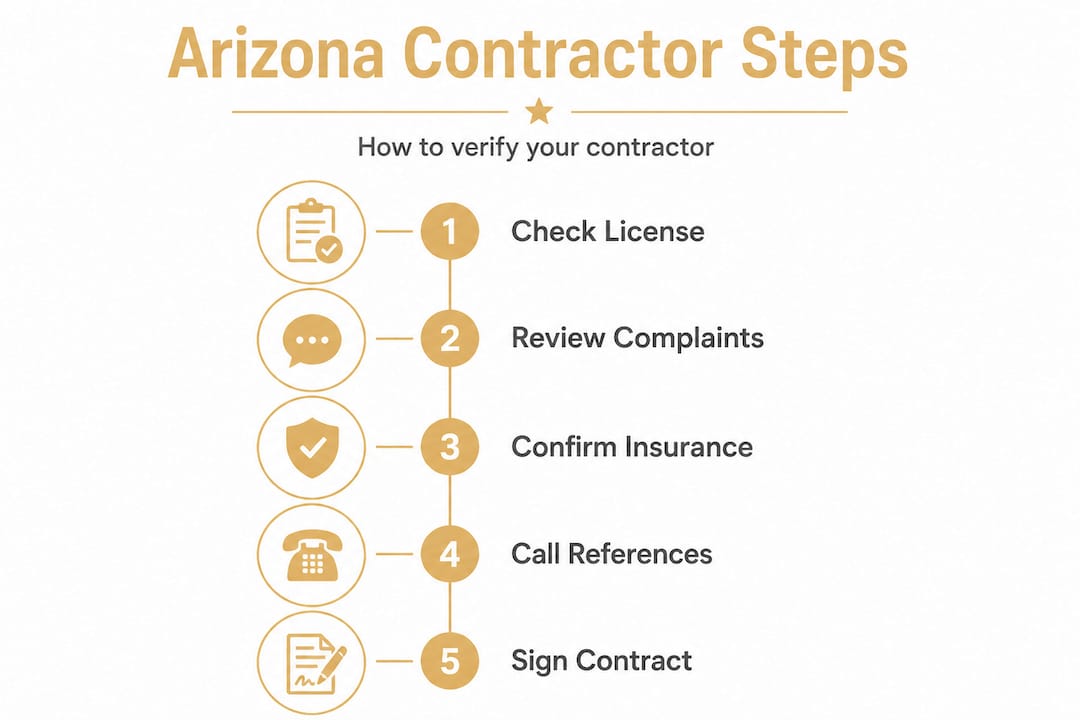
When you verify a contractor's status through the ROC, you get more than just a license number. You can see their complaint history, the status of any past violations, and whether their license is currently active or has been suspended. This takes about five minutes online and can save you months of grief.
Here is a quick breakdown of what the ROC covers:
| ROC Feature | What It Means for You |
|---|---|
| License verification | Confirm the contractor is legally allowed to work on your home |
| Complaint history | See if past clients have had disputes with this contractor |
| Recovery Fund | Compensation option if a licensed contractor does faulty or incomplete work |
| Formal complaint process | A structured way to escalate disputes without going straight to court |
Beyond verification, permits are another layer of protection most homeowners overlook. Any structural, electrical, plumbing, or significant cosmetic work in Buckeye, Goodyear, or Phoenix typically requires a permit from the city. Permits trigger inspections, and inspections catch problems early, before they become expensive disasters hiding behind drywall. A contractor who pushes back on pulling permits is a contractor trying to avoid accountability.
Written documentation is equally non-negotiable. Every conversation about scope, cost, timeline, and materials should be confirmed in writing. Even a simple email thread can become critical evidence if a dispute arises later.
"Homeowners can file a formal complaint (including for remodel and repair disputes) and may pursue Recovery Fund claims for poor workmanship or non-performance by licensed residential contractors."
The ROC Recovery Fund is a genuine financial safety net. If a licensed contractor fails to complete your project or leaves it in a defective state, you may be eligible to recover compensation through this fund. It is not unlimited, and there are eligibility requirements, but it is a powerful tool that most homeowners do not know exists until it is too late to use it.
For a broader picture of how Arizona contracting regulations work from start to finish, it pays to read up before your first contractor call.
Key protections you should always use:
- Verify ROC license status before any conversation about cost or scope
- Check complaint history, not just license status
- Confirm permits are pulled before work begins
- Get every agreement in writing, including minor change decisions
- Understand the Recovery Fund exists before you need it
Skipping any of these steps does not just expose you to bad work. It removes your legal options when you need them most.
Step-by-step: How to find and vet general contractors in the West Valley
With legal requirements and protections in mind, here's how to actually find, check, and compare contractors for your project.
Finding a contractor is easy. Finding the right one takes deliberate effort. The West Valley has no shortage of contractors advertising in Goodyear, Buckeye, and the Phoenix metro, but the quality and accountability vary wildly. Here is a process that consistently separates the professionals from the risks.
Step 1: Build your initial list Start with referrals from neighbors, your HOA, or local community groups on social media. Word-of-mouth is valuable, but it is a starting point, not a final answer. Ask specifically about recent projects and whether the person would hire that contractor again today.
Step 2: Check the ROC database for every name on your list This is not optional. Go to the ROC website and search each contractor by name or license number. Look for an active license in the correct classification for your project type. A license in commercial construction does not automatically qualify someone for residential remodeling work. Also read through any complaint history carefully, one old complaint that was resolved professionally tells a different story than three recent open complaints.
Step 3: Ask for local references and actual project examples Request the names and contact information of at least three clients from projects completed in the last 18 months. Call them. Ask whether the job finished on time, whether the final cost matched the estimate, how the contractor handled unexpected problems, and whether they would hire them again. A contractor confident in their work will not hesitate to connect you with past clients.
Step 4: Confirm insurance and bonding Ask for a certificate of insurance that shows general liability coverage and workers' compensation. Do not just take their word for it. Call the insurance company directly to confirm the policy is active. Bonding protects you if the contractor fails to complete the job or causes damage and cannot pay for it.
Step 5: Get multiple detailed estimates Collect written estimates from at least two or three contractors who have passed your vetting checks. A vague estimate that lists "materials and labor" without itemization is a warning sign. You need to know exactly what materials will be used, what brands, what quantities, and what the labor breakdown looks like.
Step 6: Compare using a structured approach
| Evaluation Factor | What to Look For |
|---|---|
| ROC license status | Active, correct classification |
| Complaint history | None or resolved with explanation |
| Insurance | General liability plus workers' comp confirmed |
| References | Recent, local, willing to speak freely |
| Estimate quality | Itemized, detailed, with timeline |
| Communication speed | Responsive, clear, professional |
Pro Tip: Do not automatically choose the lowest bid. In West Valley remodeling, a bid that comes in significantly lower than others usually means the contractor is cutting corners on materials, underestimating the scope, or planning to hit you with change order charges later. Price is one factor, not the only factor.
Common contractor red flags include refusing to provide an ROC license number upfront, giving verbal-only estimates, pressuring you to sign quickly before you can compare options, and asking for more than 10 to 15 percent as an initial deposit. Any of these warning signs should stop your process immediately.
Step 7: Shortlist and meet in person Once you have narrowed it down to two or three candidates who passed every check, meet them at your home for a walkthrough. Watch how they listen, how they respond to questions, and whether they point out issues you had not considered. A contractor who treats your home as a job site rather than a project they genuinely care about completing well is not the right fit.
The contract essentials: Payment, change orders, and documentation
Once you've found your contractor, it's time to get everything in writing and establish clear, enforceable terms.
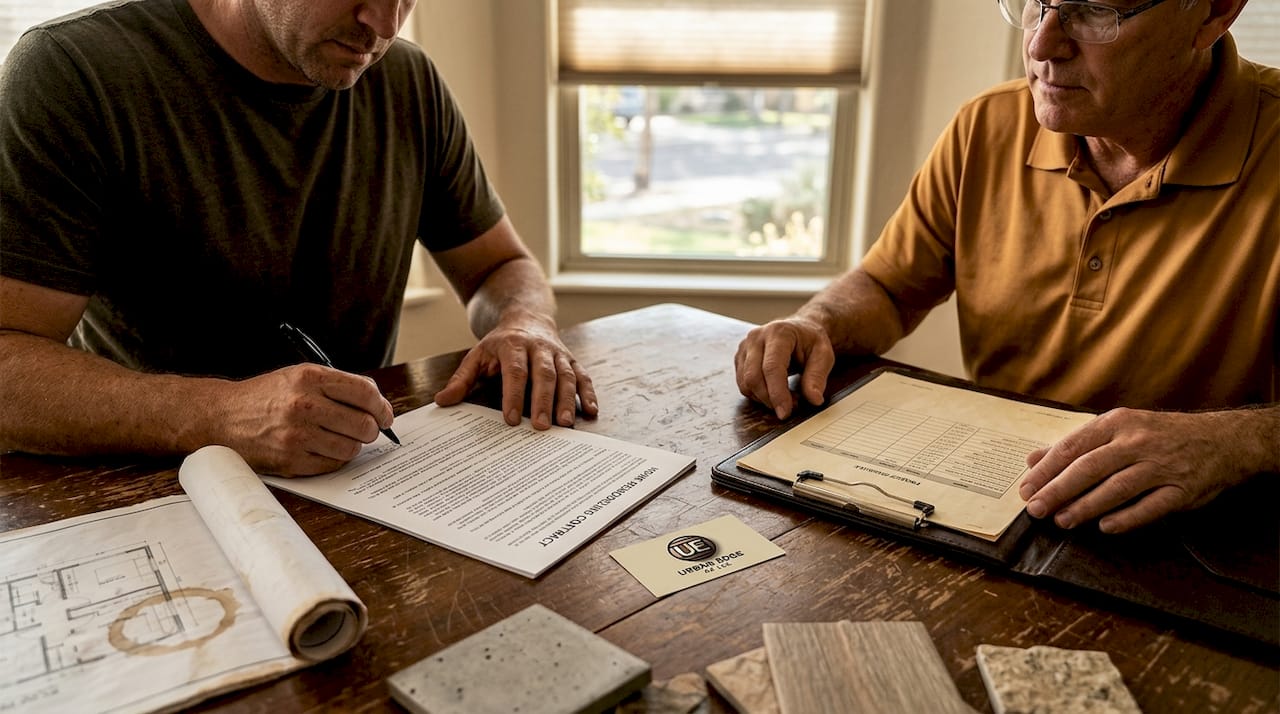
A verbal agreement with a licensed contractor is worth almost nothing when a dispute arises. The contract is your primary protection, and getting it right before work begins is far easier than trying to untangle a mess halfway through a remodel. Here is what every residential construction contract in the West Valley should include.
Scope of work: The contract must describe in specific detail what work will be done, what materials will be used (including brands and specifications), what areas of the home are affected, and what is explicitly excluded from the scope. Vague language like "update kitchen" creates room for disagreement about what was promised.
Timeline: Include a project start date, a projected completion date, and key milestones along the way. For larger remodels, a timeline chart showing which phases happen in which weeks keeps everyone aligned and gives you a basis for discussion if the project falls behind.
Payment schedule: This is where many homeowners make a painful mistake. Milestone-based payment structures tied to verifiable project stages are the industry standard for good reason. For example: 10 to 15 percent at signing, a portion at framing completion, another at rough-in inspections passing, and the final payment only after the finished work passes your walkthrough and any required inspections.
Never pay large sums upfront. Contractors who demand 50 percent or more before work begins are not operating in your interest. Arizona law limits upfront deposits for residential work, and any contractor asking for excessive advance payments is either a financial risk or planning to prioritize another job with your money.
Change orders: Every project has surprises. Materials get discontinued, hidden issues emerge behind walls, or you decide you want a different tile halfway through. Every single change, whether it adds cost or saves cost, must be documented in a written change order signed by both parties before the work changes. The steps for contracting and change order management are skills worth learning before your project starts.
A signed change order is the difference between a manageable adjustment and a disputed invoice that ends up in front of the ROC.
Final payment retention: Withhold the final payment, typically 10 percent or whatever the contract specifies, until the job passes all required inspections and you have completed a thorough walkthrough. Any punch list items (minor finishing tasks remaining at the end of a project) should be completed before you release that last payment.
Documentation habits that protect you:
- Take dated photos at every project stage, before work starts, after demolition, and after each major phase
- Save all receipts for materials, especially if you are purchasing any directly
- Keep every email, text, and written communication in a dedicated folder
- Request lien waivers from subcontractors and material suppliers as the project progresses
For specific kitchen remodeling contracts and what to expect in the West Valley, understanding what a professional scope of work looks like helps you identify gaps in any contract you receive.
Pro Tip: Before signing, have someone you trust review the contract alongside you. A second set of eyes often catches exclusions or vague language that the contractor may be counting on you to miss.
A critical statistic: Industry data consistently shows that homeowners who establish milestone payments and written change orders before work begins resolve disputes at a significantly higher rate without litigation, saving both time and legal costs compared to those operating on vague or verbal agreements.
Resolving problems: What to do if things go wrong
Even with preparation, disputes can happen. Here's how to use Arizona's consumer tools if resolving a problem becomes necessary.
If your project goes off track, your first instinct might be to call a lawyer or stop all payments immediately. Both reactions can actually hurt your position if done without following the right steps first. Arizona gives you a structured path that is more effective and less expensive than jumping straight to litigation.
Step 1: Document everything immediately The moment you identify a problem, start creating a written record. Take photos, write down dates and descriptions of the issue, and note any conversations you have had about it. If you have not been doing this throughout the project, start now.
Step 2: Communicate in writing with your contractor Send a written notice (email is fine, but certified mail creates a stronger record) describing the specific problem, what resolution you expect, and a reasonable deadline for a response. This gives the contractor a chance to correct the issue and creates the paper trail you need if escalation becomes necessary.
Step 3: File a complaint with the ROC If the contractor does not respond adequately, the ROC complaint process is your next step. Gather your contract, photos, payment records, and written communications, then file a formal complaint through the ROC website. The ROC will investigate and can require the contractor to correct defective work or face license consequences.
Step 4: Consider the Recovery Fund If the contractor has completed work that is defective, unsafe, or incomplete and cannot or will not make it right, the Recovery Fund may provide compensation. This fund is specifically designed as part of Arizona's consumer protection framework for exactly these situations. There are claim deadlines and eligibility requirements, so act promptly.
Step 5: Explore additional remedies Arizona's contractor licensing laws include provisions beyond the ROC process. Small claims court, mediation, and civil litigation remain options, but the ROC route often resolves disputes faster and at no cost to the homeowner. An attorney specializing in construction disputes can advise you if the situation involves significant amounts or complex liability.
"Don't rely only on civil litigation: ROC's complaint process and Recovery Fund route are explicitly part of Arizona's consumer protection framework for homeowners dealing with licensed contractor disputes."
Knowing how to recognize the early signs of contractor problems puts you in a much stronger position before a dispute escalates.
What to keep in your records:
- Original signed contract and all change orders
- Payment receipts and bank transfer records
- All written communications (email, text, letters)
- Dated photos at every project stage
- Permit documents and inspection reports
The homeowners who successfully use the ROC process are the ones who kept records from day one. Those who struggle are the ones who trusted verbal agreements and cannot prove what was promised.
The realities of hiring: What most guides don't tell Arizona homeowners
Here is something we see regularly in the West Valley, and it does not get discussed enough in typical hiring guides: most project disasters are entirely preventable, and most of them happen for the same reason. Homeowners know the steps exist. They just do not follow them completely because the process feels slow when you are eager to start a remodel.
The ROC system only works if you actually use it. Verifying a license takes five minutes. Checking complaint history takes another three. But when a neighbor recommends a contractor enthusiastically, or when you are excited about finally getting your kitchen done, those eight minutes feel like unnecessary friction. That friction is the entire point. It is what separates a protected project from a nightmare scenario.
The most common pattern we see is not a homeowner hiring an obviously shady contractor. It is a homeowner skipping the ROC check for someone who seemed trustworthy, agreeing to a verbal scope because the written contract "would come later," and paying 50 percent upfront because the contractor said materials needed to be ordered immediately. Each individual decision seems reasonable in the moment. Together, they strip away every protection Arizona law provides.
The extra one to two weeks you spend on proper research, reference calls, and contract review before a project starts is genuinely one of the highest-return investments you can make. It routinely saves homeowners months of dispute resolution and thousands of dollars in contested costs or repair work.
The insight most articles miss is this: the homeowners who have smooth projects are not lucky. They are disciplined about avoiding costly mistakes that feel minor in the moment. A friend-of-a-friend recommendation is valuable social signal, but it is not a substitute for ROC verification, insurance confirmation, and a written contract. Treat the process as non-negotiable regardless of how confident you feel about the person in front of you.
The tools exist. Use every single one of them, every time.
Connect with trusted Arizona contractors
If you have read this far, you are already approaching your project more carefully than most West Valley homeowners do. That preparation matters, and it pairs best with a contractor who operates the same way you do: with documentation, transparency, and accountability built into every stage.

Urban Edge AZ LLC works with homeowners across Buckeye, Goodyear, and the broader Phoenix West Valley to deliver remodeling and construction projects that are fully ROC-compliant, properly permitted, and backed by clear written agreements. From initial design to final walkthrough, every project is managed with the kind of structure this guide describes. Browse our local contracting services to see how we approach projects, or explore our kitchen remodeling expertise for one of the most common and high-value West Valley remodels. You can also review our completed project gallery to see the results firsthand. When you are ready, book a consultation to discuss your specific project needs.
Frequently asked questions
How do I check if an Arizona contractor is properly licensed?
You can verify a contractor's licensing and complaint history directly through the Arizona ROC's online database, which is publicly accessible and free to use.
What payment schedule is safest when hiring a contractor?
Milestone-based payments are safest, meaning you release funds only when specific, verifiable stages of the project are complete and inspected, never paying large sums upfront.
What should I do if my contractor doesn't finish the work?
Document the issue thoroughly, send a written notice to the contractor, and file a complaint with the Arizona ROC to access dispute resolution and potentially the Recovery Fund.
Are there risks to hiring contractors without a written contract?
Yes, operating without a written contract removes your legal protection for scope, payment terms, and dispute resolution, and is one of the most significant red flags in any contractor relationship.