

Hiring the wrong contractor in Arizona can turn a dream remodel into a financial nightmare. Unlike many states, Arizona enforces strict licensing laws through the Registrar of Contractors (ROC), and homeowners who skip the verification process risk losing thousands of dollars, facing project shutdowns, and getting stuck with no legal recourse. A bad hire isn't just inconvenient. It can void your homeowner's insurance and leave you personally liable for injuries on your property. This guide walks you through every step of the process, from understanding state requirements to signing a solid contract, so you can hire with confidence and protect your investment.
Table of Contents
- Understand Arizona contractor requirements
- Prepare your project and shortlist qualified contractors
- Check critical contractor credentials and insurance
- Negotiate, contract, and manage your Arizona project
- Why rushing or skipping steps risks disaster in Arizona
- How Urban Edge makes hiring safe and stress-free
- Frequently asked questions
Key Takeaways
| Point | Details |
|---|---|
| Check licensing first | Verifying your Arizona contractor’s ROC license and classification is your best protection against costly mistakes. |
| Get at least three bids | Request multiple itemized bids to spot quality, pricing, and project approach differences. |
| Never pay full upfront | Limit deposit to 10–50% and tie payments to completed milestones and inspections. |
| Insist on a written contract | A detailed contract with timelines, payment terms, and change orders locks in your legal rights and clarity. |
| Use only licensed pros for major work | The Arizona ROC Recovery Fund protects homeowners only if they hire licensed contractors. |
Understand Arizona contractor requirements
Before you call a single contractor, you need to understand what Arizona law actually requires. This isn't just bureaucratic fine print. It directly affects your legal protections, your insurance coverage, and whether you can recover money if something goes wrong.
Arizona requires a valid ROC license for any residential project exceeding $1,000 in combined labor and materials, or any job that requires a permit. That threshold is lower than most homeowners expect. A bathroom tile refresh, a new water heater, or a fence replacement can all cross it quickly.
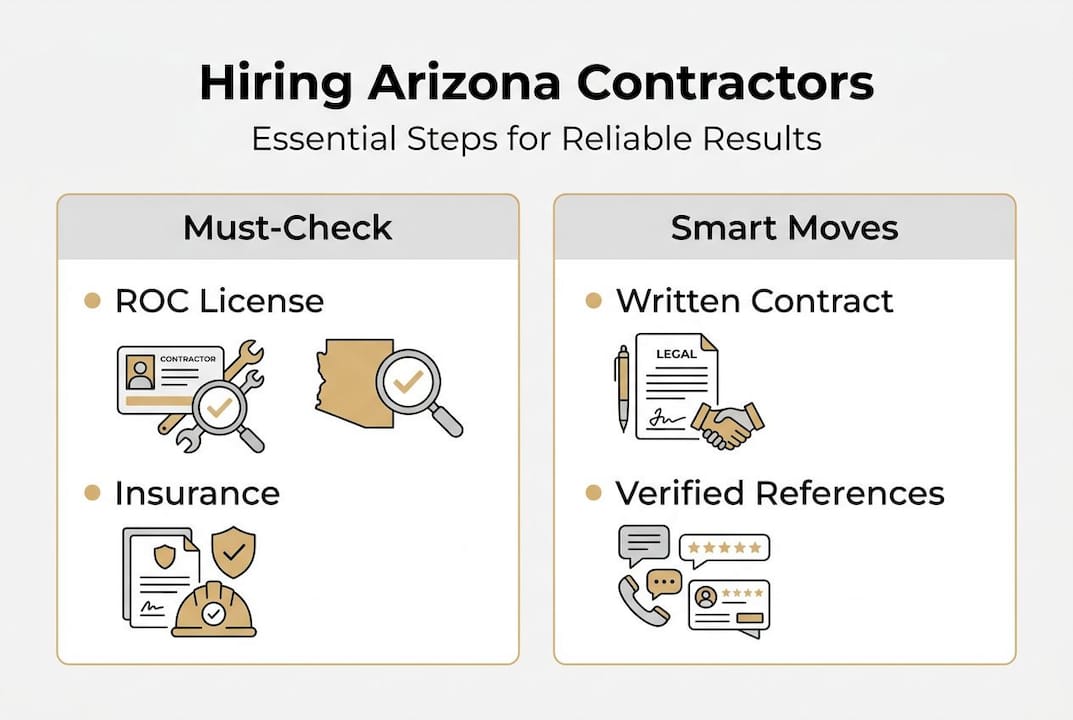
Not all licenses are the same, and matching the license class to your project matters. Arizona uses a classification system, and a contractor licensed for general residential work isn't automatically qualified for specialty trades. The ROC license classifications break down as follows:
| License Class | Scope of Work |
|---|---|
| B-2 | General residential contractor (new builds, major remodels) |
| B-3 | Small commercial and residential structures |
| R-61 | Residential remodeling and repair |
| R-62 | Residential specialty work (specific systems) |
There is a handyman exemption in Arizona. For single-trade jobs under $1,000 that don't require a permit, a contractor can legally work without a license. But here's the catch: you lose all state protections the moment you go that route. No ROC complaint process. No Recovery Fund access. No bond coverage.
Warning: Hiring an unlicensed contractor for a job that requires a license can result in your project being shut down mid-construction. You may also be held liable for injuries to workers on your property, and your homeowner's insurance may deny claims related to the work.
Key risks of skipping this step:
- Insurance claims related to the project can be denied
- You lose access to the ROC Recovery Fund
- Substandard work has no state-backed remedy
- The contractor faces no accountability for defects or abandonment
Always verify the correct license class, bond status, and complaint history through the ROC contractor database before moving forward. Practicing contractor due diligence steps from the start saves you from costly surprises later.
Prepare your project and shortlist qualified contractors
Understanding requirements sets the groundwork. Next, prepare your project details and find qualified contractors.
Start by writing out exactly what you want done. Be specific about materials, finishes, square footage, and any structural changes. The more detail you provide, the more accurate your bids will be and the easier it is to compare contractors fairly. Vague project descriptions lead to vague bids, and vague bids lead to disputes.
Once your project is defined, match it to the right license class using the table above. Then build your shortlist using multiple sources:
- Referrals from neighbors and friends in the West Valley area who have had similar work done
- The ROC database, which lets you search by trade and location
- Review platforms like Angi or Houzz, which aggregate verified homeowner reviews
- Local building supply stores, where staff often know which contractors are active and reputable
From that list, get 3+ bids with itemized line items for labor, materials, and timeline. Avoid any contractor who gives you a lump sum with no breakdown. That pricing style makes it nearly impossible to track where your money goes or dispute overcharges.
When you contact each candidate, ask for:
- Proof of ROC license and bond
- Current general liability and workers' compensation insurance certificates
- References from at least two recent projects similar to yours
- Photos of completed work
Pro Tip: Arizona's dry, dusty climate means demolition and construction create serious mess. Ask every contractor about their site protection plan. A professional crew will have a clear process for dust containment, property protection, and daily cleanup. If they look confused by the question, that tells you something.
Watch for red flags: a contractor who won't provide documentation, bids dramatically below everyone else, or asks for full payment upfront. Review Arizona handyman laws if your project is smaller in scope, since the rules shift significantly below the $1,000 threshold. Following AZ contractor best practices from the shortlisting stage protects you before the contract is even written.
Check critical contractor credentials and insurance
With a shortlist, it's time to dive into credential checks. This is the most critical protection step, and it takes less than 30 minutes if you know where to look.
Follow these steps in order:
- Search the ROC database at roc.az.gov using the contractor's name or license number. Confirm the license is active, not expired or suspended.
- Check the license classification matches your project type. An unlicensed or misclassified contractor creates serious project risk, even if the work looks good initially.
- Review complaint history on the ROC profile. One resolved complaint may be normal. Multiple open complaints or disciplinary actions are a serious warning sign.
- Request insurance certificates for both general liability and workers' compensation. Review the coverage amounts and expiration dates.
- Confirm bond status directly through the ROC profile.
| Credential | What to Check | Where to Verify |
|---|---|---|
| ROC License | Active status, correct class | roc.az.gov |
| General Liability | Coverage amount, expiration | Insurance certificate |
| Workers' Comp | Active policy, no lapses | Insurance certificate |
| Bond | Active, amount adequate | roc.az.gov |
Pro Tip: Don't just look at the documents a contractor hands you. Call the insurance company directly using the number on the certificate to confirm the policy is active. Fraudulent or lapsed certificates are more common than most homeowners realize.
On payments: never pay cash or large lump sums upfront. Arizona norms cap deposits at 50% for service work, with the remainder tied to project milestones. This protects you if the contractor walks off the job or delivers substandard work. Applying insurance and bond best practices at this stage is one of the strongest safeguards you have. You can verify license online in minutes, so there's no reason to skip this step.
Negotiate, contract, and manage your Arizona project
With credentials checked, it's time to ensure you lock in protection through smart contracts and oversight.
Start by comparing your itemized bids side by side. Don't automatically choose the lowest price. Instead, evaluate what each bid includes, what it excludes, and whether the scope matches your written project description. Negotiate based on specifics, not gut feeling.
Your contract must be written and must cover:
- Full scope of work, including materials, brands, and specifications
- Project timeline with start date, milestones, and completion date
- Payment schedule tied to milestones or inspections, not arbitrary dates
- Change order process, requiring written approval before any extra work begins
- Lien release clauses to protect you from subcontractor disputes
- Warranty terms covering both labor and materials
A written contract with scope, timelines, payment milestones, and warranties is not optional. It's your primary legal protection if the relationship breaks down.
On deposits: typical Arizona contracts call for 10 to 50% upfront, with 50% being common for service work. Never pay more than 50% before work begins, and always pay by check or card so you have a paper trail.
Important: The Arizona ROC Recovery Fund reimburses homeowners up to $30,000 per claim if a licensed contractor fails to complete work or causes damage. This fund is only available if you hired a licensed contractor and filed a formal ROC complaint. It's one of the most powerful protections Arizona homeowners have, and you forfeit it entirely by hiring unlicensed.
Must-have contract clauses at a glance:
- Scope of work and material specifications
- Change order requirements in writing
- Milestone-based payment schedule
- Lien release from subcontractors
- Warranty for labor and materials
- Dispute resolution process
Pro Tip: Keep a project log. Document every conversation, take photos at each stage, and save all written change orders. If a dispute arises, your documentation is your evidence. Applying solid contract and payment strategies from day one puts you in control of the project.
Why rushing or skipping steps risks disaster in Arizona
Here's what years of managing West Valley projects have actually taught us: the homeowners who get burned almost never hired a stranger off the street. They hired someone a friend recommended, felt comfortable, and skipped the paperwork because the relationship felt trustworthy.
That's the most common regret we hear. A warm referral is a starting point, not a substitute for verification. A contractor who works unlicensed on a small job may be fine for a $500 repair, but the moment a job crosses into permit territory or involves structural work, the stakes change completely.
"Contractors who can't be bothered with paperwork usually cut corners elsewhere. The documentation process isn't bureaucracy. It's a direct signal of how they run their business."
We've seen underbidding contractors win jobs on price, then disappear mid-project or use substandard materials to recover their margin. Licensed professionals don't just meet state requirements. They bring organization, accountability, and insurance that protect you from liability you didn't even know you were taking on.
The goal isn't to pay more. It's to avoid the catastrophic cost of fixing someone else's shortcuts. Applying project management lessons from real West Valley experience means treating every hire, big or small, with the same level of scrutiny.
How Urban Edge makes hiring safe and stress-free
If you're ready for your next step, Urban Edge puts all these best practices to work on every single project.

At Urban Edge AZ LLC, we verify ROC licensing, bond status, and insurance before any work begins. Every project comes with a written contract, transparent itemized bids, and milestone-based payment schedules so you always know where your money is going. We serve homeowners across Buckeye, Goodyear, and Phoenix with the same process every time: no shortcuts, no surprises. Whether you need a full remodel, a new build, or reliable handyman repairs, get a free consultation and see what stress-free project management looks like when it's done right.
Frequently asked questions
What happens if I hire an unlicensed contractor in Arizona?
You risk legal penalties, no access to the ROC Recovery Fund, and possible denial of insurance claims or project shutdown. Unlicensed contractor risks include full personal liability for injuries on your property.
What's the standard deposit for home contractor jobs in Arizona?
Typical deposits run 10 to 50%, with 50% common for service work. All payments should be tied to progress milestones, never paid in full upfront or in cash.
Can a handyman work unlicensed in Arizona?
Yes, for single-trade residential jobs under $1,000 with no permit required. But the handyman exemption means you lose state protections and have no ROC recourse if the work fails.
How do I verify a contractor's license and bond status?
Use the official ROC contractor database to check license status, classification, bond, and complaint history in one place.
What protections does the Arizona Residential Recovery Fund provide?
The Recovery Fund reimburses up to $30,000 per claim for licensed work, but only if you hired a licensed contractor and filed a formal ROC complaint.