

TL;DR:
- Proper project management is essential to prevent delays and budget overruns during West Valley home remodels. Establishing a firm scope, building a comprehensive budget, and maintaining consistent communication with contractors are critical early steps. Utilizing specialized software and local resources enhances oversight, ensuring the remodel meets standards while controlling costs.
Remodeling a home in West Valley should be exciting. Too often, it turns into a stressful cycle of missed deadlines, unexpected bills, and contractors who seem to operate on their own schedule. The root cause is almost never the contractors themselves. It's the absence of solid project management for remodels from day one. When you don't have a structured plan governing scope, budget, permits, and communication, small problems compound fast. This guide gives you a practical, West Valley-specific framework to keep your remodel on track, on budget, and built to a standard you're actually proud of.
Table of Contents
- Key takeaways
- Project management for remodels: before you break ground
- Managing execution: keeping your remodel on track
- Common pitfalls and how to sidestep them
- Tools and resources for smarter remodel management
- My honest take on project management in West Valley remodels
- How Urbanedgeaz helps West Valley homeowners remodel with confidence
- FAQ
Key takeaways
| Point | Details |
|---|---|
| Freeze your scope early | Locking down decisions before demolition prevents the cost escalations that derail most remodels. |
| Budget beyond the obvious | Permits, inspection fees, and a 15% contingency must be built into your numbers from the start. |
| Milestone check-ins matter | Scheduled reviews during execution catch problems early before they become expensive corrections. |
| Inspections don't guarantee quality | Passing an inspection confirms code minimums, not workmanship; your contractor owns that responsibility. |
| Right tools reduce chaos | Purpose-built remodeling software and a solid home renovation checklist cut miscommunication and keep everyone accountable. |
Project management for remodels: before you break ground
The work you do before a single wall comes down determines whether your remodel runs smoothly or falls apart under pressure. Most West Valley homeowners underestimate this phase completely.
Define and freeze your scope
Scope creep is the single biggest budget killer in residential remodeling. Project managers consistently stress that establishing a firm scope freeze before demolition is non-negotiable. Every change you make mid-project triggers a ripple effect: rescheduled trades, reordered materials, revised permits, and extra labor hours. What feels like a small upgrade to a fixture or a layout tweak can add thousands to your final bill.
Write down exactly what is included in the project and, just as importantly, what is not included. Get your contractor to sign off on that document. This becomes your reference point every time someone suggests a change.
Build a complete budget
A realistic budget for a West Valley remodel includes more line items than most people expect. Here's what needs to be accounted for:
- Construction costs: Labor and materials for the actual work
- Permit fees: Arizona residential permits run between $500 and $2,500, or 1 to 5% of construction cost in 2026
- Inspection fees: Required at multiple phases and often overlooked in initial budgets
- Design and architectural fees: If drawings or plans are needed for permit approval
- Contingency fund: Set aside at least 10 to 15% of your total budget for surprises inside walls, under floors, or in the electrical system
- Temporary housing or storage: If your project displaces you or fills your living spaces
| Budget category | Estimated cost range | Notes |
|---|---|---|
| Permits (Arizona) | $500 to $2,500+ | Based on project scope and valuation |
| Inspection fees | $150 to $500 per phase | Number of phases varies by project type |
| Contingency reserve | 10 to 15% of total budget | Non-negotiable for older West Valley homes |
| Design/architectural | $1,500 to $8,000+ | Required for structural or permit-driven changes |
| Contractor labor | 40 to 60% of total budget | Varies by trade complexity |
Pro Tip: When getting contractor bids, ask for a line-item breakdown rather than a single lump sum. This makes it far easier to identify where costs are high and what can be adjusted without compromising quality.
Verify licenses, insurance, and references
Arizona requires contractors to hold a valid ROC (Registrar of Contractors) license. Before signing anything, confirm your contractor's license is current and check for any complaints filed against them. Well-reviewed contractors who communicate clearly and work from established trade relationships dramatically reduce coordination delays throughout your project.
Ask for proof of liability insurance and workers' compensation. In West Valley cities like Buckeye and Goodyear, the permit process also requires licensed trade contractors for electrical, plumbing, and HVAC work specifically. Verify this before you assume your general contractor has it covered.
Set a realistic timeline with milestones
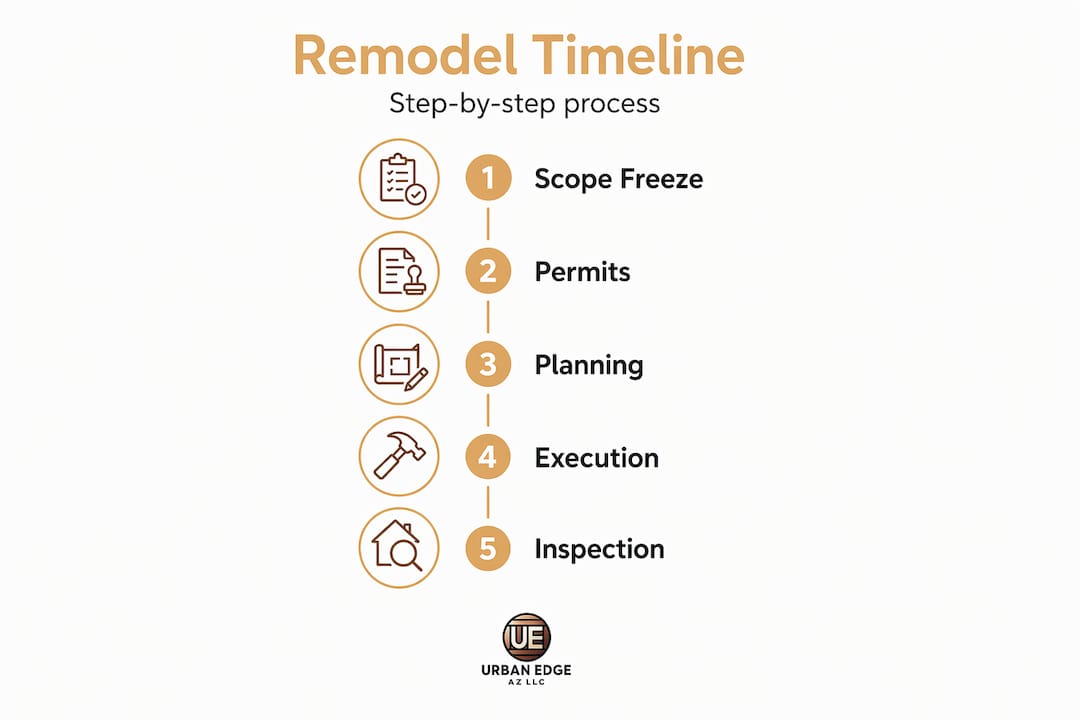
Most kitchen remodels alone require 9 or more months of planning before construction even begins, with 5 months of active build time following that. Homeowners who rush this phase nearly always run into sequencing problems once work starts. Build your timeline around concrete milestones: permit approval, demolition, rough-in inspections, finish work, final inspection, and punch list completion. These checkpoints give you clear moments to assess progress and catch drift before it compounds.
Managing execution: keeping your remodel on track
Once work begins, your role shifts from planner to monitor. This is where remodel project planning either pays off or falls apart.
Phase your work and build in buffer time
No remodel runs on a perfect schedule. Trades depend on each other in sequence: framing must be done before rough electrical, rough electrical before insulation, insulation before drywall. When one phase slips, everything downstream shifts. Build buffer time of 3 to 5 days between major phases. This isn't pessimism. It's the difference between a minor delay and a cascading schedule failure.
Here's a practical execution sequence to follow:
- Confirm all permits are approved before any demolition begins. Starting without permits in Maricopa County can result in stop-work orders and mandatory tear-outs.
- Conduct a pre-construction meeting with all key trade contractors to align on schedule, site access, and material delivery windows.
- Set a weekly check-in cadence with your general contractor. Frequent milestone reviews help surface problems early and keep the project moving in the right direction.
- Track every expenditure in real time. Don't wait for invoices to pile up. A simple shared spreadsheet or a dedicated app keeps your running total visible.
- Approve all change orders in writing before work proceeds. Verbal agreements on changes are where budget overruns are born. Every modification to scope or cost needs a signed document.
- Schedule material deliveries to arrive just before they're needed, not weeks in advance. West Valley summers are brutal, and materials stored on-site are exposed to heat, theft, and damage.
- Conduct quality walkthroughs at the end of each phase, not just at final inspection. Looking at framing before drywall goes up takes 20 minutes and can save you from opening walls later.
Pro Tip: Create a shared communication channel with your contractor, such as a group text thread or a project app. Decisions made in person and never documented are the leading cause of "I thought you meant" disputes later.
Understand what inspections actually confirm
This is something most homeowners get wrong. Inspections are sampling-based, meaning an inspector checks representative portions of the work rather than every connection, every fastener, and every foot of wire. Passing an inspection confirms that what was checked met code minimums at that moment. It does not validate the overall quality of your contractor's work.
The practical takeaway: your contractor is responsible for workmanship standards, not the city inspector. Your own quality walkthroughs and your contractor's accountability matter more than the inspection pass/fail result.
Common pitfalls and how to sidestep them
Even well-planned remodels hit trouble. Knowing what goes wrong most often puts you in a position to prevent it.
Mid-project changes are the costliest mistake most homeowners make. The excitement of seeing progress tends to spark new ideas. "What if we moved that wall another two feet?" "Can we add a second sink?" Each change triggers a chain reaction through scheduling, materials, permits, and labor. Clients routinely underestimate how quickly these escalations compound. The discipline to say no to changes after scope freeze is a financial skill, not a creative limitation.
Scheduling conflicts between trades are almost inevitable in complex remodels. The electrician needs the framing done. The tile installer needs the plumbing rough-in complete. When one trade runs late, the next one is double-booked or unavailable when you need them. A detailed home renovation checklist that maps trade dependencies in sequence is your best tool against this problem. Build your complete construction checklist before you start and update it weekly.
Miscommunication is the silent project killer. A study of construction project failures consistently points to communication breakdowns as the primary cause of delays and rework. This includes decisions made verbally that were never written down, design details that were assumed rather than confirmed, and material specifications that got lost between the designer, contractor, and supplier.
"The difference between a remodel that finishes on time and one that doesn't usually comes down to documentation and communication, not skill or materials. Most problems are preventable if the right people have the same information at the same time."
Overconfidence in inspections as a quality guarantee is another trap. As covered above, inspections test compliance with minimum standards. You need independent verification through your own walkthroughs and, on larger projects, a third-party inspection at critical phases.
Financial flexibility without losing control is a balance worth discussing. A contingency fund exists to be used. But use it only for genuine surprises, not for scope additions or upgrades. Keep a clear line between your original approved budget and your contingency column. When contingency spending starts, document why. This practice tells you whether you're dealing with legitimate unforeseen conditions or scope creep in disguise.
Tools and resources for smarter remodel management
The right tools reduce the mental load of tracking a remodel. They don't replace judgment, but they make it easier to catch problems before they become expensive.
Project management software options
Remodeling-specific software like Buildertrend, Houzz Pro, and Buildxact are built for residential construction workflows. They handle scheduling, budget tracking, document storage, and client-contractor communication in one place.
| Tool | Best for | Key feature |
|---|---|---|
| Buildertrend | Full remodel oversight | Schedule, budget, and messaging in one platform |
| Houzz Pro | Design-forward projects | Mood boards integrated with project management |
| Buildxact | Budget-focused tracking | Estimating and cost tracking for smaller teams |
| Google Sheets | Simple tracking on a budget | Customizable, free, and universally accessible |
Pro Tip: You don't need the most sophisticated software to manage a remodel well. A shared Google Sheet for budget tracking and a group messaging app for daily updates covers 80% of what most homeowners actually need.
AI tools: useful but limited
AI tools can improve scheduling, permit tracking, and communication workflows, but they work best as a support layer, not a replacement for experienced judgment. An AI system can flag a scheduling conflict or remind you about a permit renewal deadline. It cannot evaluate whether a subcontractor's rough plumbing meets your quality standard or negotiate a change order effectively on your behalf. Technology enhances traditional project management but the site-specific decisions still need human expertise.
Checklists and local resources
A thorough home renovation checklist covering pre-construction, active build, and post-construction phases keeps everyone honest. Your checklist for an Arizona remodel should also include West Valley-specific items:
- Maricopa County or city-specific permit submission requirements (Buckeye, Goodyear, and Surprise each have their own portals)
- Arizona heat considerations for material storage and crew scheduling
- HOA approval requirements, which are common in planned communities throughout West Valley
- Final inspection scheduling and certificate of occupancy requirements before re-occupancy
You can also review a detailed remodeling guide for West Valley to make sure you're not missing any local-specific steps before construction starts.
My honest take on project management in West Valley remodels
I've seen the full spectrum of how West Valley remodels go. Projects that run like clockwork. Projects that finish six months late and $40,000 over budget. The difference almost never comes down to the quality of the trades. It comes down to what happened before the first nail was driven.
In my experience, the homeowners who struggle most are the ones who treat the planning phase like a formality. They get excited about the finished result, they want to start, and they skip or rush through scope definition, permit preparation, and contractor alignment. Then the surprises start. And once a project is in motion, correcting course is expensive.
What I've found actually works is treating scope freeze like a contract with yourself. Before demolition begins, every decision that can be made should be made. Tile selection. Fixture specs. Cabinet layout. Electrical locations. The time you spend resolving these questions in the planning phase costs nothing. The time you spend resolving them during construction costs real money and real days.
The other lesson I keep coming back to is communication frequency. Weekly check-ins feel like a lot when things are going well. They feel absolutely critical the moment something starts to slip. I'd rather have a contractor tell me on a Tuesday that a material delivery is delayed by three days than find out on a Friday when the tile installer shows up to a bare floor. Early information gives you options. Late information just gives you problems.
West Valley has its own rhythm. The summer heat changes how exterior work gets scheduled. The permit offices in Buckeye, Goodyear, and Surprise each run a little differently. The HOA landscape here is denser than most markets. These aren't obstacles. They're variables that experienced local management already has factored in. If you're working with a contractor who doesn't know the local permit culture, you'll pay for that education one way or another.
Take charge of your project. Ask the questions. Demand the documentation. But know when to hand the complexity to professionals who do this every week.
— Tucker
How Urbanedgeaz helps West Valley homeowners remodel with confidence
If you've read this far, you already know that effective home renovation management is more than just hiring good trades and hoping for the best. It takes structured planning, local knowledge, and consistent oversight from start to finish.

Urbanedgeaz brings full project management to every remodel it handles in West Valley, covering Buckeye, Goodyear, and Phoenix. That means scope planning, permit coordination, contractor scheduling, budget tracking, and quality walkthroughs built into every project from day one. The team understands local permit offices, HOA requirements, and the seasonal scheduling realities of Arizona construction. Whether you're renovating a kitchen, adding a bathroom, or taking on a whole-home remodel, Urbanedgeaz gives you the structure and professional oversight that keeps projects on track and on budget. Ready to get started? Book an onsite consultation and walk through your project with a team that manages West Valley remodels every week.
FAQ
What is project management for remodels?
Project management for remodels is the process of planning, coordinating, and overseeing all phases of a renovation to keep it on schedule, within budget, and built to quality standards. It covers scope definition, permits, contractor coordination, and communication throughout the project.
How much should I budget for permits in Arizona?
Arizona residential remodeling permits typically cost between $500 and $2,500, or 1 to 5% of the total construction cost, depending on project scope. Inspection fees at multiple phases should also be budgeted separately.
Why do remodel budgets go over so often?
Budget overruns most often result from mid-project scope changes, unforeseen conditions inside walls or under floors, and inadequate contingency planning. Setting a firm scope freeze before demolition and maintaining a 10 to 15% contingency fund significantly reduces this risk.
Do I need a project manager for a home remodel?
Not every remodel requires a dedicated project manager, but every remodel benefits from project management practices. For complex multi-trade projects or whole-home renovations, a general contractor who provides active project management oversight is strongly recommended.
What tools help with remodel project management?
Purpose-built tools like Buildertrend, Houzz Pro, and Buildxact handle scheduling, budgeting, and team communication for residential remodels. For simpler projects, a shared spreadsheet combined with a detailed home renovation checklist covers the core tracking needs effectively.