

TL;DR:
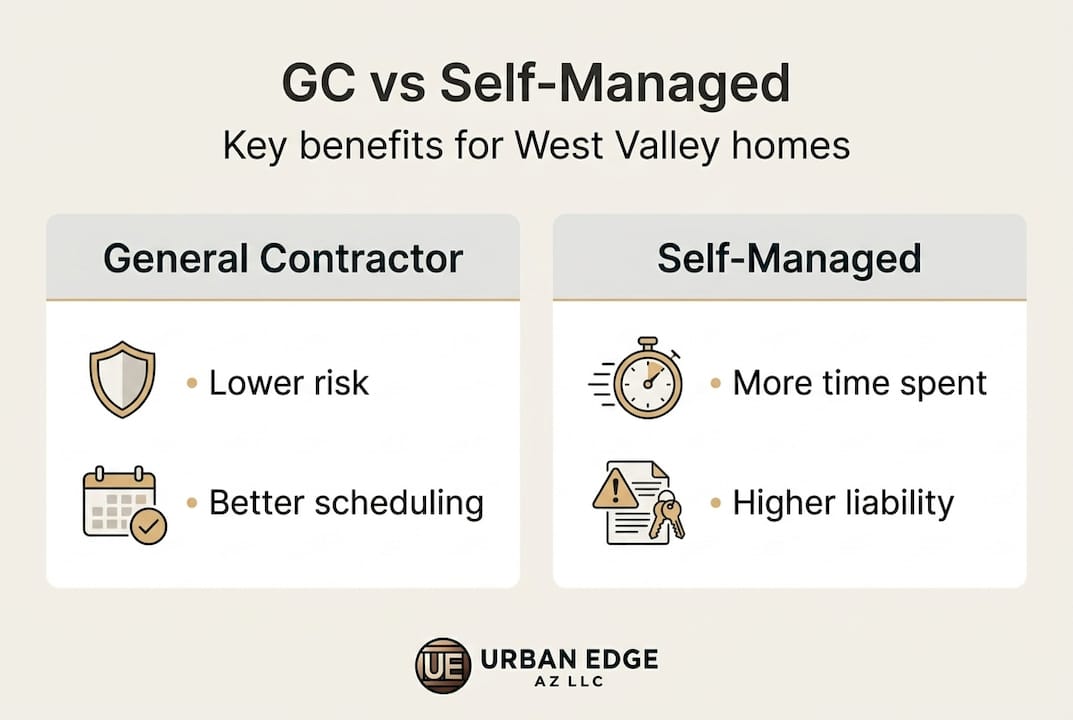
- Hiring a general contractor ensures proper project management, permits, and legal liability protection.
- Self-managing can lead to higher costs, delays, inspection failures, and lack of warranty coverage.
- Complex projects over $25,000 or involving multiple trades strongly benefit from professional GC oversight.
Many West Valley homeowners believe they can save a significant chunk of money by acting as their own general contractor, coordinating trades and pulling permits without professional help. It sounds logical on the surface. But research tells a very different story. Self-managing as owner-GC exposes you to budget overruns, project delays, legal liability for on-site injuries, failed inspections, and zero warranty protection on completed work. Trades also charge homeowners roughly 20% more than they charge established general contractors. This article breaks down exactly what a general contractor does, the real risks of going it alone, and how to decide what's right for your specific project in Buckeye, Goodyear, or the greater Phoenix West Valley.
Table of Contents
- What does a general contractor actually do?
- Risks and challenges of self-managing your project
- When should you hire a general contractor in West Valley AZ?
- Cost comparison: GC versus self-managed projects
- Why most experts and homeowners prefer hiring a general contractor
- Connect with trusted general contractors for your West Valley project
- Frequently asked questions
Key Takeaways
| Point | Details |
|---|---|
| Reduce risk and liability | Hiring a general contractor protects you from common pitfalls, legal risks, and quality issues in remodeling. |
| Save time and stress | A GC handles project coordination, permitting, and communication so you can focus on enjoying your home. |
| Get reliable outcomes | Successful projects over $25,000 or involving multiple trades are more likely when managed professionally. |
| Local expertise matters | GCs in West Valley AZ know area codes, reliable trades, and local permit processes for smoother builds. |
What does a general contractor actually do?
A lot of homeowners picture a general contractor as a middleman standing on-site in a hard hat, collecting a check. That image undersells the role by a wide margin. A qualified general contractor is actually the engine that keeps your entire project from falling apart, and their value shows up most clearly when things get complicated.
Project management and scheduling
The single biggest function of a general contractor is managing every moving part of your project simultaneously. On a kitchen remodel, for example, you might need a demolition crew, a plumber, an electrician, a tile installer, a cabinet specialist, and a painter to show up in a very specific sequence. If the plumber finishes late, the tile installer cannot start. If the tile installer is already booked elsewhere, you wait weeks. A GC prevents that chain reaction by building a realistic schedule and holding every subcontractor accountable to it.
Think about what that coordination actually looks like in practice. The GC is making multiple calls per day, tracking material deliveries, rescheduling workers when supply delays hit, and problem-solving on the fly when a wall turns out to hide unexpected plumbing or electrical runs. That is a full-time job, not a weekend task.
Permits and inspections
Arizona building codes require permits for structural work, electrical upgrades, plumbing modifications, and HVAC changes. Pulling those permits incorrectly, or skipping them, creates serious problems when you sell your home or file an insurance claim. A general contractor handles the permit process end to end, knows which inspectors cover which jurisdictions in the West Valley, and knows how to prepare work so it passes inspection the first time.
Risk, liability, and insurance
Licensed general contractors carry general liability insurance and workers' compensation coverage. If a subcontractor is injured on your property and you hired them directly without a GC, you may be personally liable. That is not a theoretical risk. Arizona courts have seen homeowners face significant legal and financial consequences because they bypassed professional GC oversight. When you hire a qualified contractor, that liability shield transfers to them.
Cost control through trade relationships
Here is something most homeowners do not realize: GCs buy materials and labor at negotiated rates that individual homeowners simply cannot access. They have long-term relationships with plumbers, electricians, and suppliers who give them preferential pricing in exchange for steady work. That purchasing power partially offsets the GC's markup. Speaking of markup, the GC markup of 15 to 25% is justified specifically by the risk management, coordination labor, and time savings they deliver to you.
"The GC's markup isn't just profit, it's the price of not having to manage 12 different phone numbers, chase down a missing material delivery, or explain permit violations to a city inspector."
One point of contact
One of the most underrated benefits is simplicity. Instead of managing five or six different trade relationships, you have one conversation with one person who is accountable for the whole project. That single point of contact reduces stress, miscommunication, and the risk of trades blaming each other when something goes wrong.
If you want to see what professional project management looks like for West Valley homeowners, the GC services in West Valley provided by Urban Edge AZ LLC give you a concrete example of how end-to-end coordination is handled locally. For homeowners specifically planning kitchen work, the kitchen remodeling expertise they offer reflects how multi-trade projects get managed under one roof.
- Scheduling and sequencing all subcontractors
- Handling permit applications and inspection readiness
- Carrying liability insurance and workers' comp
- Negotiating material and labor costs with vendors
- Serving as the single accountable point of contact
- Providing warranty coverage on completed work
Every one of those functions requires experience, local knowledge, and professional relationships that take years to build. A homeowner stepping into that role on their first or second project is starting from zero.
Risks and challenges of self-managing your project
Now that you know what GCs do, let's examine the real risks of skipping them altogether. Because the risks are not just inconvenient; some of them are genuinely expensive and legally serious.
Time: the most underestimated cost
People calculate cost savings in dollars but forget to calculate them in hours. Self-managing a remodel realistically takes 10 to 20 or more hours per week for planning, vendor calls, scheduling, material sourcing, permit tracking, and on-site oversight. That is essentially a part-time second job layered on top of your existing work and family responsibilities. For most West Valley homeowners juggling careers and kids, that math does not pencil out.
And those hours are not just inconvenient. Every hour you spend coordinating workers is an hour you are not doing whatever generates your income. The opportunity cost alone can erase any savings you expected.
Higher trade costs without a GC relationship
This one surprises people. Trades actually charge homeowners more, not less, when there is no GC involved. The reason is simple: working directly for homeowners is riskier for subcontractors. Homeowners change their minds more frequently, delay decisions, sometimes cannot pay on time, and lack the professional credibility that signals a smooth job. To offset that risk, many tradespeople add a premium to their homeowner rates. Industry data shows that trades charge 20% more when working directly for homeowners rather than through an established GC.
That 20% can quickly approach or exceed the GC's markup, which means you are not actually saving what you thought.
Failed inspections and code violations
Passing a building inspection requires more than doing the work correctly. It requires doing the work in the sequence and manner that your local jurisdiction expects, with the right documentation, and with inspections scheduled at the right phases of construction. Homeowners who pull their own permits often fail inspections because they did not know what sequence was required or what specifically inspectors look for. Failed inspections cost money in rework and create delays that push your project timeline out by weeks.
Pro Tip: Before pulling any permit yourself, call your local city or county building department in Buckeye, Goodyear, or Phoenix and ask specifically what phase inspections are required for your project type. This one conversation can save you a failed inspection and a significant amount of rework time.
Liability for on-site injuries
If you hire a plumber directly and that plumber trips and falls on your property, you may be responsible. Without a GC holding workers' comp insurance over the project, the liability exposure falls to you as the property owner. Arizona homeowners have been personally named in injury lawsuits that arose from projects where they hired trades directly. That is a financial risk that most people never consider when they are shopping for savings.

No warranty protection
When a GC oversees your project, the work typically carries a warranty. If the tile cracks six months later or the new electrical circuit fails, you have recourse. When you self-manage and hire individual trades, each trade's warranty only covers their specific scope, and disputes about who is responsible for defects often go nowhere. You end up paying twice.
Statistic to know: Projects with professional GC oversight have significantly lower rates of rework, inspection failures, and budget overruns than owner-managed projects, based on consistent expert consensus across the construction industry.
If you want a checklist of warning signs to look for when evaluating any contractor you bring onto your project, reviewing common contractor red flags is a smart step before signing anything.
When should you hire a general contractor in West Valley AZ?
After understanding the risks, you need to know how to decide for your specific project. The answer is not always "hire a GC no matter what." There are genuinely simple projects where a capable homeowner can manage effectively. The key is knowing where the line is.
Projects that clearly require a general contractor
The threshold most industry experts agree on is straightforward. You should hire a GC when your project involves any of the following:
- Multiple trades working in sequence (plumbing, electrical, framing, HVAC together)
- Structural changes such as removing load-bearing walls or adding square footage
- Permits required by your local jurisdiction
- A total budget above $25,000
- A tight timeline where delays carry real financial consequences
- Work on systems that affect habitability, such as electrical panels or HVAC
- Projects that will require a final inspection tied to resale or insurance
For complex residential remodeling in the West Valley including multi-trade remodels, custom homes, and additions, professional GC oversight is not just helpful, it is the difference between a successful project and a costly mistake.
In the West Valley specifically, projects like full kitchen remodels, primary bathroom additions, room additions in Buckeye or Goodyear, and custom home builds in developing communities all fall firmly in the "hire a GC" category.
Projects where self-management may be reasonable
There is a narrower category of work where an experienced homeowner can reasonably self-manage. These are typically single-trade, cosmetic, or low-complexity jobs:
- Interior painting (single trade, no permits required)
- Landscaping or hardscaping without structural elements
- Fixture swaps like replacing a faucet or light fixture without changing wiring
- Installing flooring in a single room without subfloor issues
The moment any of these projects starts to expand, which happens frequently, the calculus shifts. A flooring job that reveals rotted subfloor suddenly needs a carpenter and possibly a moisture specialist. That expansion is exactly when you want a GC already in place.
| Project type | Hire a GC? | Why |
|---|---|---|
| Full kitchen remodel | Yes | Multiple trades, permits, high budget |
| Custom home build | Yes | Structural, permits, many trades |
| Room addition | Yes | Structural, permits, high complexity |
| Interior painting | No | Single trade, no permits |
| Simple landscaping | No | Usually single trade, no permits |
| HVAC replacement | Yes | Permits, specialist coordination |
| Bathroom remodel | Yes | Plumbing, tile, electrical together |
| Fixture replacement | No | Single trade, cosmetic only |
Understanding kitchen remodeling projects in the West Valley context gives you a practical look at why even a mid-range kitchen upgrade crosses the threshold where GC oversight pays off.
Cost comparison: GC versus self-managed projects
With the GC decision framework outlined, let's look at the actual numbers involved. Because this is where a lot of homeowners get the math wrong.
The GC markup explained
General contractors typically add a markup of 15 to 25% to the total cost of a project. On a $100,000 kitchen remodel, that is $15,000 to $25,000 on top of trade and material costs. That number looks alarming on paper. But it represents something specific: the cost of having a professional manage risk, coordinate trades, handle permits, enforce quality standards, and provide warranty coverage.
That markup is not pure profit. It covers the GC's insurance premiums, licensing costs, administrative time, site visits, and the cost of the relationships that get you better trade pricing in the first place. Strip that markup out and you are not getting the same project cheaper. You are getting a different project with no safety net.
The theoretical savings of self-managing
In theory, a homeowner acting as their own GC could save 15 to 20% on a project by eliminating the GC's markup. That is real money on a large project. But that calculation only holds if everything goes according to plan, which construction projects almost never do.
The hidden costs that erode those savings include:
- Paying 20% more for trade labor without a GC relationship
- Lost time at your job or with your family
- Rework costs from failed inspections or coordination mistakes
- Material waste from incorrect ordering or damaged deliveries
- Delays that push your timeline and sometimes your living situation
| Cost factor | GC-managed project | Self-managed project |
|---|---|---|
| GC markup | 15 to 25% | 0% |
| Trade labor premium | Negotiated rates | Up to 20% higher |
| Risk of costly rework | Low | High |
| Warranty coverage | Yes | Typically no |
| Permit and inspection risk | Managed by GC | Homeowner's responsibility |
| Time cost to homeowner | Minimal | 10 to 20+ hours per week |
"The math of self-managing looks good until it doesn't. One failed inspection, one subcontractor no-show, or one material order mistake can cost more than the GC markup you were trying to avoid."
What the data actually shows
It is worth being transparent here: no direct empirical data exists comparing GC-managed versus self-managed project success rates specifically for Arizona residential remodeling. The construction industry does not have a centralized database tracking those outcomes. What does exist is a strong and consistent expert consensus built from years of contractor experience, insurance claims data, and homeowner outcome surveys.
That consensus points clearly in one direction: for projects above the complexity threshold, professional GC oversight reliably produces better outcomes. The savings from self-managing are real in ideal conditions, but the risk of non-ideal conditions is far higher than most homeowners estimate when they start planning.
Pro Tip: Before deciding to self-manage, add up your hourly rate times the estimated hours of coordination work and compare that number to the GC markup. For many West Valley professionals, the math shifts quickly in favor of hiring.
Long-term value that does not show up in the initial budget
A GC-managed project typically adds measurable value to your home through quality workmanship, proper permitting that appears cleanly on your home's records, and warranty-backed systems. When you sell a home in Goodyear or Buckeye and a buyer's inspector pulls the permit history, a clean, properly permitted remodel adds confidence and value to your asking price. A self-managed project with unpermitted work can become a negotiating liability at exactly the wrong moment.
Why most experts and homeowners prefer hiring a general contractor
Having compared the costs, let us dig into the perspective that seasoned contractors and homeowners who have lived both paths consistently share.
Here is something the DIY renovation world does not talk about enough: the real cost of a construction mistake is rarely just the cost of fixing it. It is the compound cost of delays, stress, strained relationships with trades, and the hours of your life you spent chasing a problem that an experienced GC would have caught before it happened. Industry consensus on risk reduction exists because experienced professionals have watched the same patterns play out on job sites for decades.
We have seen very capable people, engineers, project managers, and skilled tradespeople themselves, underestimate what it takes to coordinate a residential remodel from scratch in an unfamiliar jurisdiction. The West Valley has its own permit nuances, its own network of reliable and unreliable subcontractors, and its own timeline pressures driven by Arizona's construction season. That local knowledge is not something you can acquire quickly.
The homeowners who try to self-manage a complex remodel and succeed tend to have one thing in common: they already had deep industry relationships and prior construction experience. The ones who struggle are typically intelligent, motivated people who simply did not know what they did not know. No amount of YouTube tutorials replaces five years of managing projects in the field.
Hiring a qualified GC is not giving up control. You still make every design decision, approve every budget change, and set the standards for your home. What you are doing is delegating the coordination, liability, and risk management to someone whose entire professional identity depends on getting it right.
Connect with trusted general contractors for your West Valley project
You have seen the evidence. Self-managing complex projects carries real financial, legal, and time-related risks that often outweigh the potential savings. The smarter move for most West Valley homeowners is partnering with a qualified contractor who knows the local market, the local trades, and the local permit requirements inside and out.

Urban Edge AZ LLC offers West Valley general contracting services built specifically for homeowners in Buckeye, Goodyear, and Phoenix who want professional project management, transparent pricing, and warranty-backed results. Whether you are planning a full renovation, working with kitchen remodel specialists to transform your most-used space, or exploring options with custom home builders for a new construction project, the team at Urban Edge AZ handles everything from permits to final walkthrough. Book a consultation today and get a clear picture of your project costs before a single nail is driven.
Frequently asked questions
How much time does a homeowner typically spend self-managing a remodel?
Homeowners typically spend 10 to 20 or more hours each week on planning, subcontractor coordination, and on-site oversight when acting as their own general contractor, which is essentially a part-time job added on top of normal responsibilities.
Do trades charge more if no general contractor is involved?
Yes, trades often charge 20% more when working directly for homeowners rather than through an established GC, because they price in the added risk and unpredictability that comes with owner-managed projects.
What types of projects require a general contractor in West Valley AZ?
For multi-trade, permitted, or structural projects, or any project with a budget over $25,000, hiring a general contractor is strongly recommended to manage risk, ensure code compliance, and protect your investment.
Is there concrete data comparing GC-managed and self-managed project outcomes in Arizona?
No direct empirical data exists specifically for Arizona residential remodeling outcomes, but consistent industry expert consensus shows that professional GC oversight significantly reduces the risk of costly mistakes, delays, and inspection failures.