
TL;DR:
- Hiring unlicensed contractors in the West Valley can lead to failed inspections, legal issues, and costly rework later.
- Licensed contractors in Arizona are verified professionals who provide safety, legal compliance, and documentation protecting homeowners.
Plenty of West Valley homeowners have made a costly assumption: that any contractor willing to show up and swing a hammer will get the job done right. The truth is that unlicensed or unpermitted work creates serious downstream problems, including failed inspections, difficult disclosures, resale complications, and questions about documentability that can haunt you years after the project wraps up. This guide walks you through exactly what a license means, what happens when you skip that requirement, and how to confidently choose the right professional for your Buckeye, Goodyear, or Phoenix area home.
Table of Contents
- What is a licensed contractor and why does it matter?
- Key risks of hiring unlicensed contractors in the West Valley
- Documentability, inspections, and long-term value
- How to verify and choose a licensed contractor in Arizona
- The overlooked costs of cutting corners: an expert's take
- Choose the peace of mind that comes with licensed professionals
- Frequently asked questions
Key Takeaways
| Point | Details |
|---|---|
| Protects home value | Licensed contractors ensure your renovations are legally documented, preserving resale value. |
| Reduces legal risks | Hiring licensed professionals protects you from fines and costly repairs due to inspection failures. |
| Guarantees accountability | With licensing and contracts, you have recourse if things go wrong during your project. |
| Facilitates smooth inspections | Licensed contractor work passes inspections more easily and provides the paperwork buyers and appraisers want. |
| Peace of mind | You avoid stress and unexpected expenses by choosing contractors who follow the law and best practices. |
What is a licensed contractor and why does it matter?
When people hear "licensed contractor," they sometimes picture a piece of paper that someone framed and forgot about. In Arizona, a contractor's license is far more than that. It represents a documented, verified commitment to professional standards that protect you as a homeowner every single day the crew is on your property.
A licensed contractor in Arizona has gone through background screening, demonstrated knowledge of local building codes, and maintained active bonds and insurance. Bonding means that if the contractor fails to complete the job or causes financial harm, you have a financial safety net. Insurance means that if a worker is injured on your property or your property is accidentally damaged, you are not left holding the bill. These are not small protections. In a state like Arizona where summer construction can push into extreme heat conditions, worksite accidents are a genuine concern, and your personal liability exposure without a properly insured contractor can be enormous.
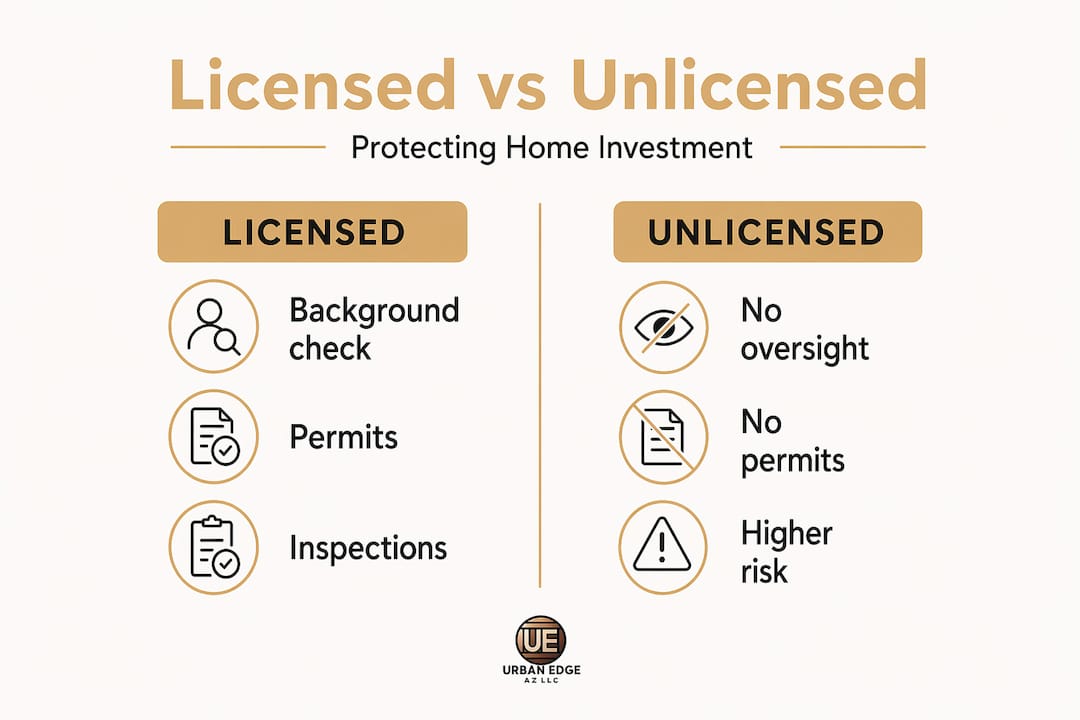
Licensing also means a contractor is answerable to the Arizona Registrar of Contractors (ROC), the state agency that licenses, disciplines, and oversees contractors. If something goes wrong with a licensed contractor, you can file a complaint, trigger an investigation, and potentially receive a remedy through state enforcement. With an unlicensed contractor, you have no such avenue. You are essentially on your own, and your only recourse may be expensive civil litigation with no guarantee of a winning outcome.
Here is what a properly licensed contractor in Arizona demonstrates before receiving and maintaining their license:
- Verified identity and background check clearance
- Proof of general liability insurance and workers' compensation coverage
- Active surety bond on file with the state
- Passing score on an Arizona contractor knowledge exam
- Demonstrated experience in their specific trade classification
- Ongoing renewal and compliance with state regulations
Understanding Arizona licensing basics is the first step toward making a smart, protective decision for your home. It also helps to understand the broader scope of what a general contracting overview actually covers, because many homeowners do not realize how many moving parts are involved in even a modest remodel.
One of the most important things to understand is that permitted and licensed work is properly documented, which means it can be verified later with far less hassle. That distinction becomes absolutely critical the moment you decide to refinance, sell, or rent your home.
Pro Tip: Always ask to see a contractor's license number before any conversation about pricing. Then go directly to the Arizona Registrar of Contractors website and look it up. A legitimate contractor will encourage this. Anyone who hesitates or makes excuses is a serious red flag.
Key risks of hiring unlicensed contractors in the West Valley
The West Valley is growing fast. Buckeye has been one of the fastest-growing cities in the entire United States for several years running, and Goodyear is not far behind. That growth means a flood of contractors entering the market, and not all of them arrive with proper credentials. The demand for construction and remodeling work is so high that unlicensed operators can stay busy simply by underbidding licensed professionals on price. That lower bid is exactly where the trouble begins.
Here is a straightforward look at how the outcomes differ between licensed and unlicensed contractors:
| Category | Licensed contractor | Unlicensed contractor |
|---|---|---|
| Work quality | Held to code standards and ROC oversight | No baseline standard enforced |
| Safety compliance | OSHA and local code adherence required | No formal safety accountability |
| Legal compliance | Permits pulled, inspections scheduled | Often no permits, work may be illegal |
| Insurance coverage | Liability and workers' comp required | Typically none, exposing homeowner |
| Resale value | Work documented and verifiable | Work may require costly disclosure or removal |
| Dispute resolution | ROC complaint process available | Civil court only, expensive and slow |
The financial consequences are not abstract. Consider a homeowner in Goodyear who hires an unlicensed crew to finish their basement for $18,000, saving roughly $4,000 compared to a licensed bid. Two years later, that homeowner lists their home for sale. The buyer's inspector flags the finished space because there is no permit on file, the electrical work does not meet code, and the egress window is the wrong size. The seller now faces a choice: reduce the asking price significantly, pay a licensed contractor to tear out and redo the work correctly, or watch the deal fall apart entirely.
Unlicensed work can become a serious liability when you sell. In many cases it requires tearing out finished materials and redoing the work at the homeowner's full expense, with no ability to recover costs from the original contractor.
Here is a practical numbered list of the top risks you accept when you hire without verifying a license:
- No legal recourse for poor workmanship. The ROC cannot help you if the contractor was never licensed. You are in civil court territory from the start.
- Full liability for on-site injuries. If an uninsured worker is hurt on your property, your homeowner's insurance may not cover it, and you could face a personal lawsuit.
- Code violations and fines. Unpermitted work can result in city or county fines, mandatory demolition, and required reinspection at your expense.
- Failed home inspections. Buyers or their lenders will often reject a home where unpermitted work is discovered, killing the sale.
- Expensive redo costs. Fixing improperly done work typically costs more than doing it right the first time, because demo and disposal are now added to the labor bill.
- Homeowner's insurance complications. Some policies will deny claims for damage caused by or related to unlicensed, unpermitted work.
Watch for contractor red flags before signing anything. And make sure you understand what remodeling contracts in Arizona should actually include, because a proper written contract is your second layer of protection after the license itself.
Documentability, inspections, and long-term value
Here is something that does not get discussed enough when West Valley homeowners are planning a remodel or build: the paperwork is almost as important as the physical work itself. Permits, inspection sign-offs, material specifications, change orders, and contractor certifications are the paper trail that proves your home improvement was done legally, safely, and to code. Without that trail, you are essentially asking future buyers, inspectors, and lenders to take your word for it.
Licensed and permitted work is documented and verifiable, which is exactly what downstream stakeholders like appraisers and buyers' agents want to see. When the work has a paper trail, negotiations are smoother, appraisals are more favorable, and buyers feel confident. When work cannot be verified, everything becomes a question mark, and question marks cost you money.
A licensed contractor will coordinate permit applications with the city or county, schedule required inspections at each phase of the project, and provide you with final documentation once the job passes inspection. They know which stages require a licensed inspector to physically observe the work before it gets covered up, such as framing, electrical rough-in, or plumbing. That inspection process is not just bureaucratic red tape. It is an independent check that the work is structurally sound and safe.

Here is how the long-term risk profile compares between documented licensed work and undocumented unlicensed work:
| Risk factor | Licensed and documented | Unlicensed and undocumented |
|---|---|---|
| Failed home inspection | Low risk, permits on file | High risk, no verification possible |
| Appraisal impact | Neutral to positive | Potentially negative or flagged |
| Resale complications | Minimal with paperwork | Significant, may require disclosure |
| Legal liability | Contractor bears responsibility | Homeowner absorbs full risk |
| Insurance claim denial | Unlikely if work is permitted | Possible or likely depending on issue |
| Future renovation conflicts | Easy to build on permitted work | New contractors often refuse to extend unlicensed work |
One scenario that West Valley homeowners often do not consider is the renovation cascade. When you decide to add a bathroom or expand a kitchen five years from now, a licensed contractor will look at the existing work. If that existing work was never permitted or inspected, your new contractor may be required by code to address deficiencies before they can legally proceed. What started as a savings of a few thousand dollars can suddenly balloon into a project that costs tens of thousands to untangle.
Pro Tip: Create a dedicated folder, physical or digital, for every contractor document from your project. Include the permit number, inspection records, warranty paperwork, and any change orders. When you sell, this packet tells the buyer's team a clear, verifiable story. Skimping on this step can cost you far more in negotiation losses than you saved anywhere else.
For more guidance on selecting the right professional from the start, take a look at how to hire reliable contractors in Arizona, which covers practical steps for the full vetting process.
How to verify and choose a licensed contractor in Arizona
Knowing why licensing matters is valuable. Knowing exactly how to verify and choose a licensed contractor is what actually protects you. Here is a step-by-step process you can follow before you sign any agreement or write any check.
Steps to verify a license and choose the right contractor:
- Start at the Arizona Registrar of Contractors. Visit the ROC website and search by contractor name or license number. You can see whether their license is active, what trade classifications they hold, and whether they have any complaints or disciplinary actions on file. This search is free and takes about two minutes.
- Confirm insurance coverage independently. Ask for a certificate of insurance directly from the contractor's insurance provider, not just a copy the contractor hands you. Call the insurer to confirm the policy is active and covers the scope of your project.
- Check their bond status. Bonding protects you if the contractor abandons the job. The ROC filing will typically show bond information, but you can also request bond documentation from the contractor directly.
- Request references from similar local projects. A kitchen remodel in Goodyear requires different knowledge than a new build in Buckeye. Ask for references from projects similar in scope and location to yours, and actually call those references.
- Visit completed projects when possible. Photos are easy to find online and easy to stage. A real visit to a finished bathroom addition or remodeled living space tells you far more about craftsmanship and attention to detail.
- Compare at least three bids. A single bid gives you no context. Three bids tell you the real market range for your project and help you spot outliers, both suspiciously high and dangerously low.
Beyond the license verification, here is what a strong contractor relationship looks like in terms of contract terms and communication habits:
- A written contract that specifies scope of work, materials, timeline, payment schedule, and warranty terms
- A payment schedule tied to project milestones, not just calendar dates
- Clear communication about who pulls permits and how inspections are handled
- A single point of contact you can reach within one business day
- Written change orders for any deviation from the original scope
- A detailed warranty statement that covers both materials and labor
Transparency and compliance throughout the job matter not just to you but to every future stakeholder who touches your home, from inspectors to buyers to their lenders. A contractor who builds that transparency into their process from day one is protecting your investment as much as their own reputation.
For a detailed walkthrough of the full hiring process, the steps to hire a contractor in Arizona guide covers every phase from initial contact through final payment. You can also review expert contractor steps specifically for Arizona homeowners, and learn more about the benefits of a general contractor when your project involves multiple trades.
The overlooked costs of cutting corners: an expert's take
We have worked alongside homeowners in Buckeye, Goodyear, and the broader West Valley long enough to recognize a painful pattern. Someone receives three bids for their project. Two bids come from licensed, insured contractors with documented track records. The third bid, often arriving last and priced noticeably lower, comes from someone who cannot produce a current ROC license number without a significant delay or a suspicious excuse. The homeowner, understandably focused on budget, chooses the third option.
We are not saying every lower bid is a red flag. Competitive pricing among licensed contractors is healthy. But when the low bid correlates with an inability to show documentation, that is where the real cost hides. It does not show up on the invoice. It shows up eighteen months later when the roof flashing fails inspection, when the deck boards begin to separate because they were improperly spaced for Arizona heat expansion, or when a buyer walks away from the purchase because the addition was never permitted.
The conventional wisdom in this industry is that you get what you pay for. That is true as far as it goes. But the deeper truth is that unlicensed work often costs you twice: once when you pay for the original job and once when you pay someone else to undo and redo it properly. That second payment is always larger. It includes demo costs, disposal fees, materials, labor, permit fees that should have been paid the first time, and sometimes fines for the original violation.
There is also a psychological cost that does not show up in any contractor comparison table. When you live in a home where you are not confident the work was done correctly, that uncertainty is always present. Every time it rains and you glance at the ceiling, every time the HVAC kicks on and you wonder about the new ductwork, every time a neighbor mentions they had an issue with unpermitted work on their block. That is not a comfortable way to live in a home you have invested hundreds of thousands of dollars into.
Key general contractor services in the West Valley are designed to eliminate exactly that uncertainty. When every trade on your project is coordinated under a licensed general contractor, you have a single point of accountability, a documented paper trail, and a professional who has signed their name to the quality of the work.
The cheapest bid you receive may feel like a win in the moment. In our experience, it becomes the most expensive decision a homeowner makes. That is not an opinion shaped by wanting your business. It is a pattern we have observed repeatedly, and one that consistently holds true regardless of the size or type of project.
Choose the peace of mind that comes with licensed professionals
Every homeowner in the West Valley deserves to move through their remodel or new build with confidence, knowing the work is legal, documented, and built to last. Hiring a licensed contractor is not just a legal checkbox. It is one of the smartest financial decisions you can make for a property in one of Arizona's fastest-growing regions.

At Urban Edge AZ, we bring full licensing, bonding, insurance, and a transparent project management process to every job we take on, whether it is a complete home build in Buckeye, a full kitchen remodeling project in Goodyear, or a targeted remodel in Phoenix. We pull permits, coordinate inspections, and hand you a complete documentation packet when the job is done. Before you hire anyone, review our guide on contractor hiring red flags so you know exactly what warning signs to avoid. Then reach out and let us show you what genuinely transparent, professional contracting looks like in the West Valley.
Frequently asked questions
What could happen if I hire an unlicensed contractor in Arizona?
You risk fines, lost legal recourse, failed inspections, and expensive repairs or redone work at your expense when selling your home, with no ability to recover those costs from the original contractor.
How can I check if a contractor is licensed in Arizona?
You can verify a contractor's license number, trade classifications, and disciplinary history for free through the Arizona Registrar of Contractors online database at roc.az.gov.
Will hiring a licensed contractor increase my project's cost?
Licensed contractors may cost slightly more upfront, but they prevent costly downstream problems including fines, failed inspections, insurance claim denials, and expensive remediation that can far exceed the original savings.
Is a permit always required if I hire a licensed contractor?
Many Arizona projects require permits, and a licensed contractor will know exactly which ones apply to your scope of work, ensuring everything is properly filed and inspected so your project is fully legal and documented.