
TL;DR:
- Many West Valley homeowners face costly delays and safety risks by attempting DIY remodeling projects without proper permits.
- Hiring licensed professionals ensures code compliance, warranty protection, and faster, safer project completion.
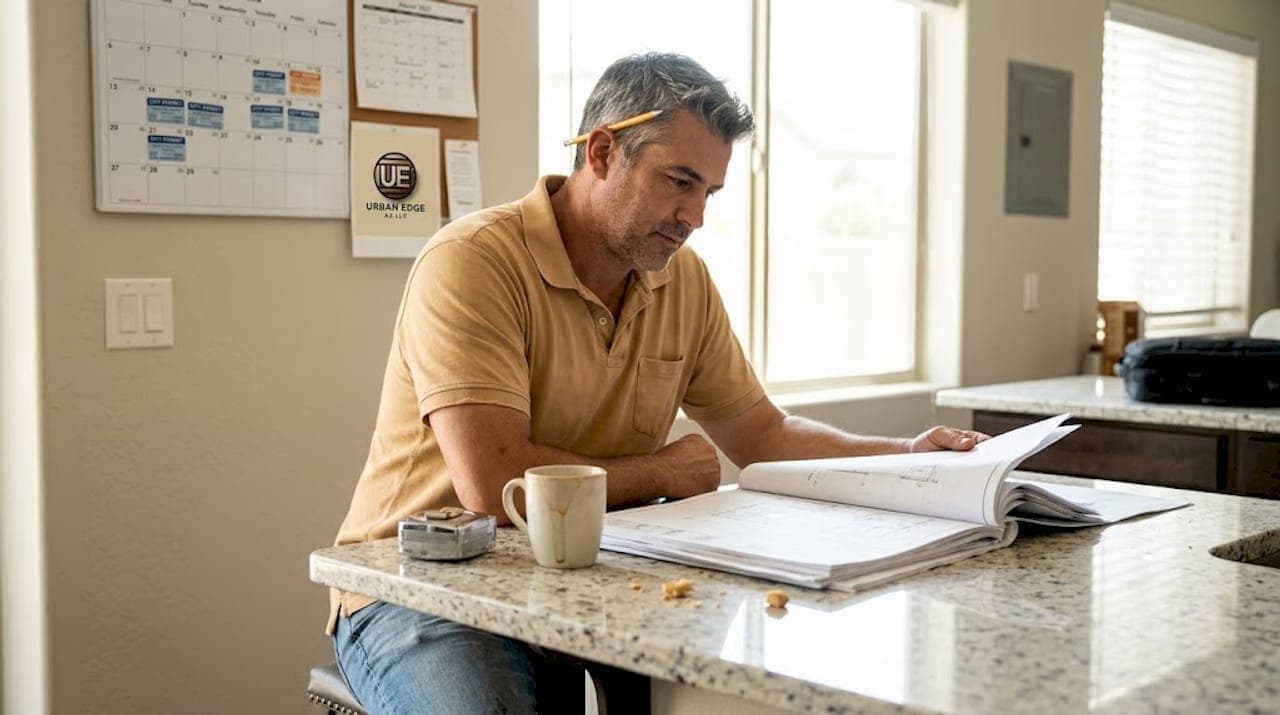
Plenty of homeowners in the West Valley have started a weekend project with a YouTube tutorial and a trip to Home Depot, only to find themselves three weeks later with a half-finished bathroom, a failed inspection, and a contractor quoting twice the original budget to fix everything. Hiring a professional contractor improves safety, reduces risk, and provides insurance and warranty protection that DIY simply cannot replicate. If you're weighing your options before a remodel or new build in Buckeye, Goodyear, or Phoenix, this guide will walk you through exactly when and why a licensed pro is the smarter investment.
Table of Contents
- When should you hire a professional contractor?
- The hidden risks and costs of DIY projects
- The professional advantage: quality, efficiency, and peace of mind
- How to make the right choice: Decision checklist for homeowners
- The inconvenient truth: Why most DIY fantasies mislead homeowners
- Ready for your next project? Work with a trusted West Valley contractor
- Frequently asked questions
Key Takeaways
| Point | Details |
|---|---|
| Risk management | Professional contractors carry insurance and handle permits, protecting you from liability and costly mistakes. |
| Quality assurance | Licensed pros deliver reliable craftsmanship, warranties, and work that meets code requirements. |
| Time savings | Contractors streamline scheduling, inspections, and project management so your remodel finishes faster. |
| Informed decision | A simple decision checklist helps you evaluate when DIY makes sense—or when hiring is the safer investment. |
When should you hire a professional contractor?
Knowing when to call a pro is half the battle. DIY can feel empowering and cost-effective on the surface, but the line between "I can handle this" and "I've made an expensive mistake" is often thinner than it looks. The key isn't whether you're handy. It's about recognizing the specific variables that turn a manageable weekend project into a multi-week nightmare.
According to the NerdWallet home improvement guide, DIY can be reasonable for low-risk, straightforward tasks, but the decision must account for safety risk, required skill level, and permitting requirements, not just upfront cost. That framing matters. Too many homeowners calculate savings based on labor alone, without factoring in the regulatory and technical layers underneath.
Here's a practical breakdown of when you should hire a professional contractor rather than attempt the work yourself:
- Structural changes: Removing or moving load-bearing walls, adding a room addition, or modifying roof structure all require permits and engineering sign-off in most Arizona municipalities.
- Electrical upgrades: Panel upgrades, new circuit installation, and any work tied to the home's wiring require a licensed electrician and city inspection.
- Plumbing modifications: Moving drain lines, adding fixtures, or rerouting supply lines aren't just technical, they carry serious water damage and health risks if done incorrectly.
- HVAC work: Arizona's extreme heat makes your cooling system critical. Any system replacement or significant ductwork modification needs a licensed HVAC contractor.
- Permit-required projects: If a job requires a permit in your city, that permit creates a formal accountability trail. Unpermitted work can block home sales and trigger fines.
In Arizona, the permit holder is legally accountable for code compliance and work quality. That's not a technicality, it's real liability. Residential permitting rules allow some homeowners to act as their own general contractor, but doing so means you are personally responsible for coordinating every subcontractor, scheduling every inspection, and catching every code violation before a city inspector does it for you.
Pro Tip: If you pull your own permit as a homeowner in Arizona, you're committing to managing every licensed trade, every inspection, and every correction yourself. That's a full-time job on top of whatever work you already have. Most homeowners underestimate this dramatically.
The West Valley general contractor services available in your area exist precisely because the permitting and coordination process is complex. A licensed general contractor doesn't just show up and swing a hammer. They manage the flow of every trade, every supplier, and every inspection on your behalf. Understanding Arizona general contracting at a deeper level makes it clear why this role is so valuable.
The hidden risks and costs of DIY projects
Understanding when you must call a professional leads to a surprising reality: even "small" DIY jobs can carry big hidden risks. The costs most homeowners never see coming aren't the obvious ones. It's rarely the cost of the tile or the lumber that hurts. It's the second and third-order consequences that show up later.
Let's start with the one that hits hardest: insurance. When you hire a licensed contractor to protect your home, their liability insurance covers damage they cause. Their workers' compensation covers injuries on your property. When you DIY, neither of those protections exist. If a subcontractor you informally hired through a classified ad gets injured on your property, you could face a lawsuit with no coverage.
"Reputable contractors typically carry insurance and provide warranties that protect homeowners if something goes wrong." This protection disappears the moment you choose to handle the work yourself or hire unlicensed help.
Here's a comparison table showing how DIY versus contractor approaches play out across common risk categories:
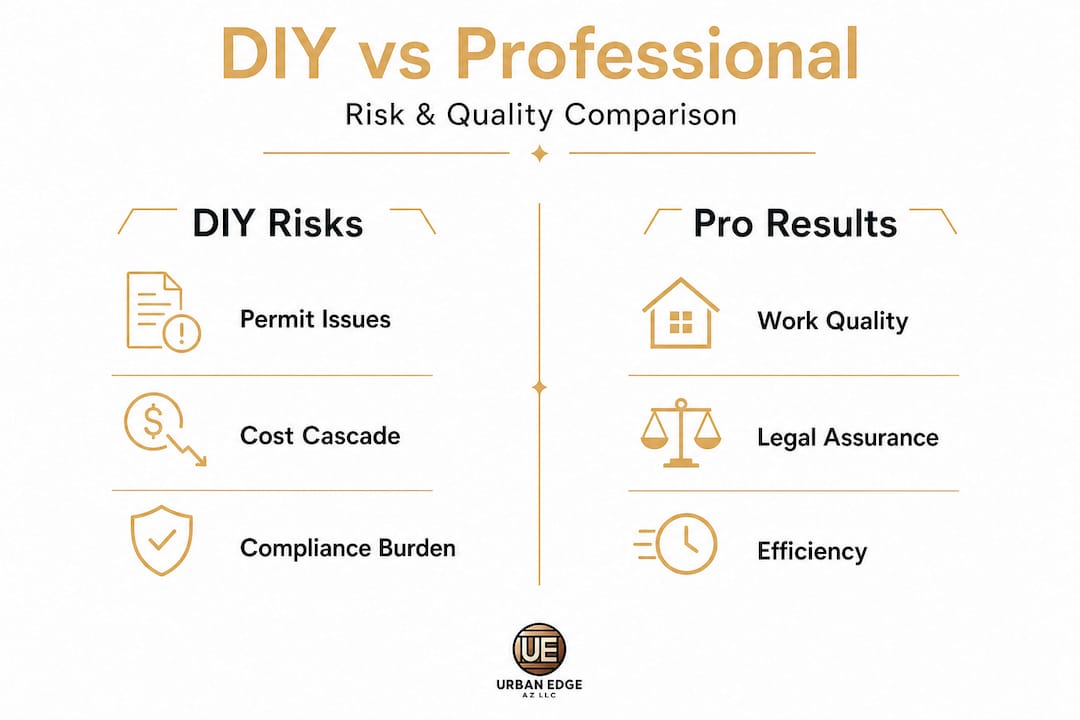
| Risk category | DIY approach | Professional contractor |
|---|---|---|
| Code compliance | Homeowner responsible; violations common | Contractor accountable; inspections managed |
| Work warranty | None | Typically 1 to 2 years on labor |
| Injury liability | Falls on homeowner | Contractor carries workers' comp |
| Failed inspections | Homeowner pays for corrections and re-inspection fees | Contractor re-inspects at their own cost |
| Material waste | Often higher due to errors and miscalculation | Minimized through professional estimation |
| Project delays | Very common without professional scheduling | Managed through structured timelines |
| Resale impact | Unpermitted work can block or reduce sale price | Permitted work adds documented value |
The hidden costs go deeper than the table suggests. Failed inspections in Arizona cities often require full tear-outs of completed work before corrections can be made. A tile floor installed over improperly prepared substrate gets ripped up. Framing that doesn't meet fire-blocking code gets opened up. You pay for the materials twice, plus disposal fees, plus your own time.
Here are additional hidden costs that catch West Valley homeowners off guard:
- Permit penalties: Working without a required permit can result in stop-work orders and fines from the city, plus mandatory retroactive permits that cost more than the originals.
- Contractor rescue costs: When a DIY project fails mid-way, a professional hired to correct it often charges a premium because fixing someone else's incomplete work is harder than starting clean.
- HOA violations: Many West Valley communities have homeowners associations with strict rules about exterior changes. Unpermitted or code-violating work can trigger fines and forced removal.
- Health and safety hazards: Incorrect plumbing can cause mold behind walls. Improper electrical work is a leading cause of house fires. These consequences often appear months or years after the project.
Using a West Valley construction checklist before any project helps you catch these risk factors early. Identifying them before you start is always cheaper than discovering them halfway through.
The professional advantage: quality, efficiency, and peace of mind

With the risks defined, let's pivot to the real, often undervalued, advantages professionals offer Arizona homeowners. The benefits of hiring a licensed contractor go well beyond "they know what they're doing." There's a structural, systemic value that touches every phase of your project from planning to final walkthrough.
Here are the five most significant advantages a professional contractor delivers that DIY simply cannot replicate:
- Warranty protection: Most licensed contractors provide a written warranty on their labor, typically one to two years. If something fails after they finish, they come back to fix it at no additional charge. You get zero of that with DIY or unlicensed help.
- Code compliance from the start: A professional knows the local building codes for Buckeye, Goodyear, and Phoenix because they work in those municipalities every day. They build to code the first time, which means fewer corrections and no surprise re-inspection fees.
- Project speed: Professionals move faster because they do the same tasks repeatedly, have established relationships with suppliers, and schedule subcontractors efficiently. A bathroom remodel that might take a homeowner six weekends takes a professional crew a fraction of that time.
- Single point of accountability: When you hire a general contractor, you have one person to call if something goes wrong. No chasing down three separate subs and hoping someone takes responsibility.
- Resale value protection: Licensed contractors who pull proper permits create a documented improvement record for your home. Buyers and their lenders look for this. Unpermitted work is often a deal-breaker or causes forced price reductions.
Here's how professional versus DIY outcomes compare across typical remodel scenarios in the West Valley:
| Project type | DIY typical outcome | Professional contractor outcome |
|---|---|---|
| Kitchen remodel | High risk of plumbing/electrical errors, permit issues | Managed permits, coordinated trades, warranty on work |
| Bathroom addition | Code compliance gaps, tile and waterproofing failures common | Proper waterproofing, inspected plumbing, finished on schedule |
| Room addition | Structural risk without engineer review | Permitted, engineered, city-inspected and approved |
| Exterior stucco repair | Moisture infiltration risk if improperly applied | Matched finish, sealed correctly, warranty backed |
| Roof work | Serious fall risk, voided manufacturer warranty | Safety-managed, manufacturer-compliant installation |
Pro Tip: Before signing any contract, ask the contractor for their Arizona Registrar of Contractors license number and their current certificate of insurance. Verify both independently. A legitimate contractor will never hesitate to provide this. You can verify Arizona contractor licenses at the state ROC website in minutes.
Understanding the residential construction workflow in West Valley gives you a clear picture of how many moving parts a typical project involves. The benefits of hiring a general contractor become obvious when you see the full picture of scheduling, sourcing, coordination, and compliance that happens before a single visible improvement is made.
How to make the right choice: Decision checklist for homeowners
Knowing the benefits, here's a practical way to evaluate your next home project: use this decision checklist. Walk through each step honestly before you start. This is the same kind of evaluation a good contractor does before quoting any job.
- Define the full scope. What exactly does the project involve? A "simple" kitchen backsplash is different from a "kitchen refresh" that includes moving a gas line and relocating a window. Scope creep is where costs explode.
- Assess the safety risk. Does the project involve working at height, with electricity, with gas, or with load-bearing elements? If yes, the safety threshold alone justifies hiring a professional.
- Check permit requirements. Contact your city's building department or look up permit requirements online. In Buckeye and Goodyear, most structural, electrical, and plumbing work requires a permit. Skipping this step is never worth the risk.
- Evaluate your actual skill level. Not the YouTube version of your skill level. Your real, honest skill level. Watching a professional install tile for twenty minutes doesn't mean you can tile a shower correctly, including the waterproofing membrane and proper grout joints.
- Calculate the true cost comparison. Add up tools you'd need to buy or rent, materials, disposal fees, your time at an honest hourly rate, and the cost of any corrections. Compare that to a contractor quote. The gap is usually smaller than you expect, especially for skilled-trade work.
- Consider your timeline. How long can you realistically live without a functional kitchen or bathroom? Professionals set firm timelines. DIY projects expand to fill available time, which is rarely as much as you planned.
- Think about resale implications. If you might sell within the next five to ten years, unpermitted or visibly amateurish work will come up in inspections and negotiations. Permitted work by a licensed contractor is a selling point.
DIY can be reasonable for truly low-risk, low-skill tasks like painting interior walls, installing pre-hung doors in existing openings, or replacing light fixtures in accessible locations. But those same factors, safety risk, required skill, and permitting requirements, should drive the decision every single time. Cost is rarely the right primary filter.
Pro Tip: If you've read through this checklist and you're still not sure whether your project needs a professional, that uncertainty is your answer. Call a licensed contractor for a consultation. Many offer free or low-cost initial assessments, and knowing the scope from a professional perspective costs you nothing compared to the price of getting it wrong.
The Arizona build and remodel guide is a valuable companion resource when you're preparing to make this decision on a specific project. It walks through the actual process of permitted construction in Arizona so you know what to expect.
The inconvenient truth: Why most DIY fantasies mislead homeowners
Here's the part that TV renovation shows and popular home improvement content never tell you. They leave out the inspection appointments that get canceled twice. They skip the part where you find out mid-project that the existing framing doesn't meet current code and now has to be brought up to standard before you can close the walls. They cut away before showing the three trips back to the hardware store, the wasted materials, and the call to a professional to fix what should have been a straightforward job.
The DIY fantasy is largely a media product. The reality of home improvement, especially in a growing market like the West Valley with active code enforcement and permit oversight, is significantly more complicated. Structural work doesn't forgive learning curves. Plumbing doesn't care that you followed the tutorial carefully. Code inspectors don't grade on effort.
What's most costly isn't always the original mistake. It's the cascade. You skip a permit because you don't want to wait. The work fails inspection when you try to sell three years later. Now you're negotiating a price reduction and hiring someone to re-do the work properly before close of escrow. At that point, you've paid three times: once for the original DIY materials, once for the professional correction, and once in reduced sale price.
From our experience working across Buckeye, Goodyear, and Phoenix, the projects that end up costing the most are almost always ones where a homeowner got 80 percent of the way through on their own, hit a wall they couldn't get past, and then called us to rescue a project that had already burned through their budget. Starting with a professional isn't always about paying more. It's often about paying less overall, finishing faster, and not carrying the stress of an open project for months longer than planned.
The West Valley contractor perspective we bring to every project is built on exactly this reality. A responsible professional contractor saves you time, stress, and money in ways that don't show up on a line-item comparison between labor costs. The value is in what doesn't go wrong.
Ready for your next project? Work with a trusted West Valley contractor
If this article has shifted how you're thinking about your next project, you're already ahead of where most homeowners start. The gap between a rewarding renovation and a costly mistake usually comes down to one decision: who you trust to do the work.

Urban Edge AZ LLC is a licensed general contracting firm serving homeowners throughout Buckeye, Goodyear, and Phoenix. As premier general contractors in the West Valley, we manage every phase of your project, from permits and planning to final inspection and warranty coverage. Whether you're considering a full kitchen renovation with our kitchen remodeling experts or planning a larger addition, we bring licensed tradespeople, transparent pricing, and real accountability to every job. Before you sign anything, take a moment to review the red flags when hiring a contractor so you know exactly what to watch for. Schedule a consultation today and start your project the right way.
Frequently asked questions
What paperwork should a professional contractor provide in Arizona?
A licensed Arizona contractor should provide their ROC license number, a current certificate of liability insurance, and a written contract that clearly outlines scope of work, timeline, payment schedule, and warranty terms. Reputable contractors carry insurance and warranties that protect you if something goes wrong after the job is complete.
Is it legal to act as your own contractor in Arizona?
Yes, Arizona allows homeowners to act as their own contractor for certain projects on their primary residence, but you'll carry full liability for code compliance, inspection results, and all work performed on the property.
What kinds of home projects always require a licensed contractor?
Electrical panel work, plumbing modifications, HVAC installation, structural changes, and any project that requires a city permit in Arizona must be performed by or overseen by a licensed contractor to meet code and pass inspection.
Why are permits so important in the West Valley region?
Permits create a legal record of safe, code-compliant work that protects your liability, satisfies insurance requirements, and is required by buyers and lenders during a home sale. Skipping required permits creates accountability gaps that can become very expensive years after the original work was done.